Self-developed CXL Controller: Samsung, SK Hynix, and Micron Shift Abandoned
2026-07-21
In July 2026, the memory industry witnessed a significant strategic realignment. According to Korean media reports, the three major DRAM manufacturers—Samsung Electronics, SK Hynix, and Micron Technology—have all scaled back or abandoned their commercialisation plans for CXL expansion device controllers.
Divergent Paths Among the Three Players
 The three manufacturers have followed different timelines and approaches in exiting self-developed controllers.
Micron has taken the most decisive step: it has shut down its CXL controller R&D division, terminated its proprietary controller development project, and turned to PrimeMass for controller solutions. Products incorporating PrimeMass controllers have already entered Micron's product catalogue.
SK Hynix has recently formally notified its major partners that it will cease in‑house CXL controller development. The company is reassigning the relevant R&D personnel to next‑generation computing memory semiconductors—specifically PIM (Processing‑in‑Memory). This move reflects its intention to concentrate limited R&D resources on memory architectures with stronger long‑term competitiveness.
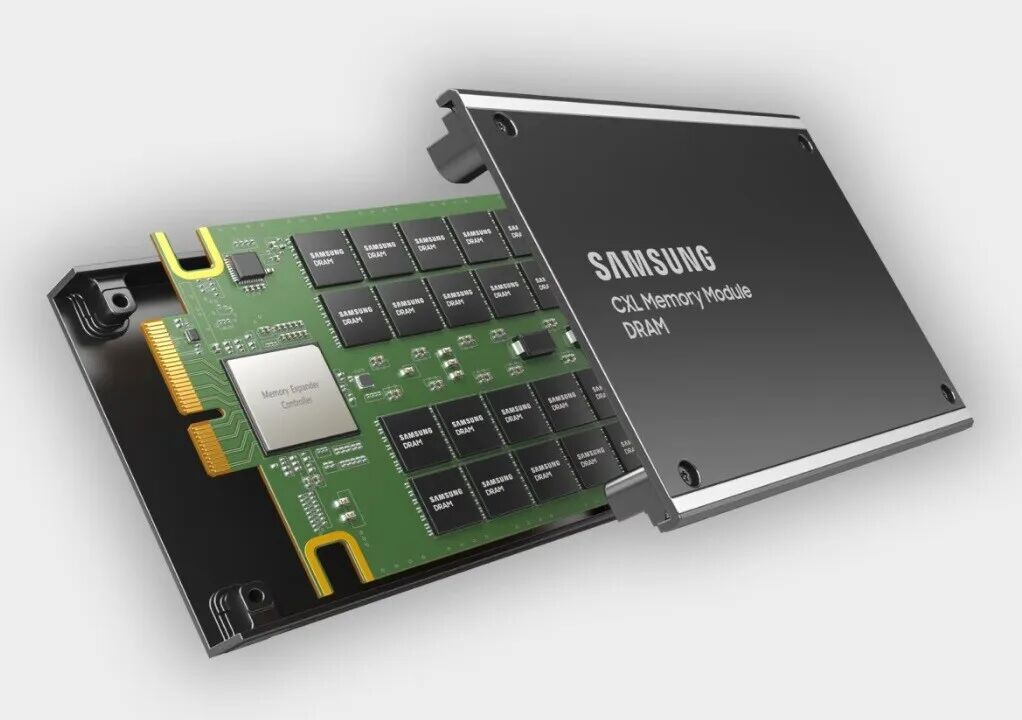
Samsung Electronics has adopted a more cautious approach. The company has removed self‑developed CXL controllers from its official commercialisation roadmap, retaining only cutting‑edge research projects. Its team now focuses on immature areas such as LPDDR‑based CXL solutions. Concurrently, Samsung has shifted to external procurement of controller products; its previously planned integrated "self‑developed controller + CXL Memory Module" offering has effectively been suspended.
Root Causes of the Strategic Shift
The three giants initially shared a common vision: integrating the controller with DRAM on the same module, delivering CXL memory as a complete solution, and leveraging self‑developed controllers to increase integration and capture higher margins. However, this vision failed to gain traction among downstream data‑centre customers.
Customers have shown a clear preference for a modular architecture—procuring DIMM memory modules and CXL controllers separately and combining them in‑house. This approach reduces procurement costs and offers greater flexibility for future upgrades and supply‑chain choices.
A deeper contradiction lies in the fact that if memory manufacturers aggressively push their own high‑end CXL controller chips into the market, they risk cannibalising their core revenue stream from general‑purpose DRAM (DIMM) sales. As industry observers have noted, if a complete CXL product directly competes with a company's own DIMM business, the commercial rationale for promoting such controllers diminishes significantly.
CXL Ecosystem Enters a Phase of Specialised Division of Labour
The withdrawal of the three major memory makers from self‑developing controllers is more emblematic of a natural specialisation process within a maturing ecosystem. Controller design is now being handed over to fabless chip design companies, while memory manufacturers continue to leverage their strengths in fabrication and DRAM technology.
Under this trend, specialised fabless firms such as Montage Technology, Astera Labs, and PrimeMass are stepping in to fill the gap in the CXL controller market. Notably, Montage Technology's CXL MXC chip complies with the CXL Type 3 specification and supports memory pooling and sharing across multiple hosts. The company launched its CXL 3.1 MXC chip in September 2025 and has already sent samples to key customers for testing. Astera Labs' Leo CXL Smart Memory Controller is the industry's first dedicated solution that simultaneously supports both memory expansion and memory pooling.
This division of roles—where fabless specialists handle controller innovation while DRAM vendors focus on core memory technologies—appears to be the more rational path forward for the CXL ecosystem, allowing each player to concentrate on its respective competitive edge.
SEMICON electronic component supplier
SEMICONE electronic component distributor, specializing in providing supply solutions for customers in terms of scarce, BOM List and discontinued chips. We have a deep focus on popular categories such as power management, analog devices, logic ICs and storage chips, and provide efficient and reliable component support for fields like automotive electronics, industrial control, communication and medical equipment. Here are some of the recently selected high-demand electronic components.
● TPSM828224SILR (TI) - 2A Buck Power Supply Module, with input range of 2.4V to 5.5V, efficiency up to 95%, integrated inductor, simplifies power supply design.
● SN75HVD08DR (TI) – RS-485/RS-422 transceiver, 3V – 5.5V wide voltage supply, data rate 10Mbps, supports 256 nodes, half-duplex.
● MT46V32M16P-5B IT:J (Micron) – 512Mb DDR SDRAM, 32M×16bit organization, 200MHz clock frequency, 2.5V–2.7V operating voltage, SOP-66 package.
● ADRF5132BCPZN-R7 (ADI) – High-power silicon SPDT RF reflection switch, with frequency range of 700 MHz – 5 GHz, insertion loss as low as 0.9 dB, isolation of 35 dB, and input third-order intercept point of 62 dBm.
● PSMN1R2-30YLDX (Nexperia) – A 30V N-channel power MOSFET with an ultra-low on-resistance of 1.2 mΩ, suitable for high-efficiency synchronous rectification, load switches, and power management applications.
Email: info@semicone.com
Intel's DCG Layoffs: Trims Its Fastest-Growing Unit
Verizon's New Round of Layoffs: 3,000 Job Cuts Behind a Strategic Transformation
Related Article

Microchip acquired VORAGO and Hailo. VORAGO adds HARDSIL tech, Hailo brings 26 TOPS processors. Both deals closed in 2026.
Microchip's Two Acquisitions: Aerospace & Defense and Edge AI

MOSFET or IGBT? Learn how to choose power semiconductors by voltage, switching frequency, and load.
MOSFET or IGBT? A Practical Guide to Power Device Selection