Sustaining Momentum: Global Foundry Industry's 2024 Q2 Revenue Growth Driven by AI Demand
2024-08-27
Against the backdrop of continuous global technological advancement, the semiconductor industry's critical segment—the foundry industry—has garnered significant attention for its development trends. According to Counterpoint Research's latest "Foundry Quarterly Tracker Report," in the second quarter of 2024, the global foundry industry achieved a revenue increase of about 9% quarter-on-quarter and approximately 23% year-on-year, demonstrating a strong rebound.
AI Demand Drives Industry Growth
The primary driving force behind this growth is the rapid development and sustained demand increase for artificial intelligence (AI) technology applications. The demand for high-performance wafers by AI chips continues to rise, propelling the expansion of the foundry industry. Particularly, the CoWoS (Chip-on-Wafer-on-Substrate) technology, known for significantly enhancing chip performance and efficiency, is currently in short supply, becoming a bottleneck in industry development. It is anticipated that future capacity expansion will focus on CoWoS-L technology to meet the market's demand for high-performance AI chips.
Rapid Recovery of the Mainland China Market
Mainland Chinese foundry companies such as SMIC (Semiconductor Manufacturing International Corporation) and Hua Hong Semiconductor, with their strong quarterly performance and positive market outlook, have become significant players in the global foundry industry. These companies' fabless semiconductor clients entered the inventory adjustment phase earlier, leading to an earlier market rebound on a global scale.
TSMC & Samsung Lead Industry Trends
As the vanguard of the global foundry industry, TSMC (Taiwan Semiconductor 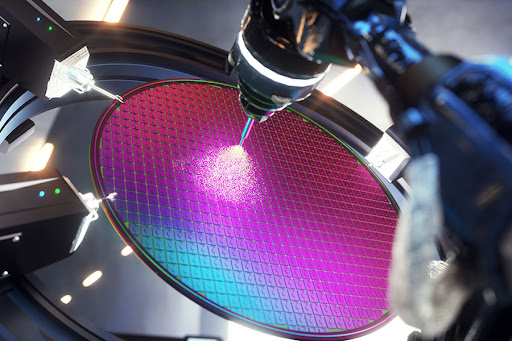 Manufacturing Company) achieved revenue in the second quarter of 2024 that exceeded market expectations, reaching 20.82 billion U.S. dollars, a year-on-year increase of 40.1%. TSMC's annual revenue forecast has also been raised from the previous range of 21% to 26% to a new range of 24% to 26%. Moreover, TSMC anticipates that the supply-demand balance for AI accelerators will remain tight by the end of 2025 or the beginning of 2026 and plans to at least double its CoWoS capacity by 2025 to meet the robust market demand for AI technology.
Manufacturing Company) achieved revenue in the second quarter of 2024 that exceeded market expectations, reaching 20.82 billion U.S. dollars, a year-on-year increase of 40.1%. TSMC's annual revenue forecast has also been raised from the previous range of 21% to 26% to a new range of 24% to 26%. Moreover, TSMC anticipates that the supply-demand balance for AI accelerators will remain tight by the end of 2025 or the beginning of 2026 and plans to at least double its CoWoS capacity by 2025 to meet the robust market demand for AI technology.Samsung Foundry, driven by smartphone inventory buildup and restocking, achieved sequential revenue growth and maintained its second position in the market with a 13% share in the second quarter of 2024. UMC (United Microelectronics Corporation) reported its quarterly performance significantly exceeded expectations, mainly due to favorable exchange rates and strict pricing capabilities, indicating a mid-single-digit sequential growth for the third quarter of 2024.
GlobalWafers' quarterly performance was stable. Despite market challenges, the automotive business still showed sequential growth, the smartphone market's inventory normalized, and the demand in the communications and IoT markets stabilized.
Challenges and Opportunities Faced by the Global Foundry Industry
Although the global foundry industry has achieved significant growth driven by AI demand, challenges such as the slow recovery of the smartphone and automotive markets persist. It is expected that the peak season performance of the smartphone market in the third quarter of 2024 may not meet expectations, and the recovery of automotive and industrial demand will also be delayed. In addition, the recovery of demand for non-AI semiconductors is relatively slow.
However, challenges and opportunities coexist. TSMC anticipates that the prices of wafers for advanced processes such as 5/4nm and 3nm may increase in 2025, providing a positive signal for the long-term growth of the foundry industry. At the same time, the strong performance of Mainland China's foundry enterprises, along with technological innovation and market adjustments in the global foundry industry, have laid a solid foundation for the industry's future development.
Conclusion
In summary, the global foundry industry showed a positive growth trend in the second quarter of 2024, especially driven by AI technology, with broad industry prospects. Despite facing challenges such as the slow recovery of the smartphone and automotive markets, the foundry industry is expected to continue growing and contributing more to global technological development as technological innovation and market demand continue to adjust. The industry also needs to pay attention to social issues arising from the development of AI technology, such as privacy and security issues, and establish and improve corresponding laws, regulations, and ethical frameworks while innovating.
Semicon IC Chip Component
|
|
|
|
|
Email: info@semicone.com
CPU Rivalry in South Korea DIY PC Market: Intel Challenges and AMD Opportunities
Humanoid Robot Controllers: The Nerve Center of Intelligent Action
Related Article

Qualcomm will begin performance-driven global layoffs in November after annual reviews, with no headcount disclosed.
Global Performance-Driven Layoffs at Qualcomm

US DHS orders DeepSeek removed from federal civilian IT systems, including third-party products using its models, turning model provenance into a procurement compliance issue.
US Federal Civilian Agencies Ban DeepSeek