Microchip's Sluggish Sales, Factory Closures, and Suspension of Subsidy Applications
2024-12-05
Recently, globally renowned microcontroller manufacturer Microchip Technology has announced a series of significant adjustments to address current unfavorable factors such as sluggish sales and inventory backlog. These measures include the closure of some factories, layoffs, and the suspension of applications for subsidies under the U.S. CHIPS Act, which has attracted widespread attention in the industry.
Microchip Technology, as a leading global microcontroller manufacturer, has a wide range of applications for its products in various fields including automotive and consumer electronics. However, in recent years, with the intensification of global semiconductor market competition and changes in demand, Microchip is also facing unprecedented challenges. Issues such as sluggish sales and inventory backlog have forced the company to re-examine its operational strategies and take corresponding adjustments.
Financial Performance and Market Performance
Microchip's financial performance in the third quarter of 2024 showed a clear downward trend. Quarterly revenue reached $1.164 billion, a significant year-on-year decline of 48.4%, and a sequential decrease of 6.2%. This decline reflects the cyclical adjustment of the semiconductor industry and the impact of weak market demand in Europe, especially in the industrial and automotive sectors. Net profit under GAAP was only  $78 million, while under Non-GAAP profit it was $250 million. In terms of stock prices, Microchip has declined by about 27% this year, becoming one of the worst-performing stocks in the Philadelphia Stock Exchange Semiconductor Index.
Factory Closures and Employee Impact
To address high inventory levels and insufficient production capacity, Microchip has decided to close its wafer manufacturing plant (Fab 2) in Tempe, Arizona, which is expected to affect about 500 employees. This decision will start to see savings in profit and loss in the September quarter of 2025, but savings in profits and losses will not be realized until the June quarter of 2026. The immediate restructuring costs for closing the factory are between $3 million and $8 million, with potential additional costs of up to $15 million in the future.
Suspension of Subsidy Applications
Microchip has become the first known semiconductor company to suspend its plans under the U.S. CHIPS Act. Microchip, which was expected to receive $162 million in funding to support the construction or expansion of its factories in Oregon and Colorado, has currently suspended negotiations with the chip office. This decision is a blow to officials in the Biden administration who are eager to complete the allocation of funds under the act.
Industry Trends and Competitors
Despite the challenges, Microchip remains optimistic about the long-term growth of  the semiconductor industry. WSTS estimates that the semiconductor market will grow by 13.1% next year, with annual sales increasing to $588.4 billion. Microchip's President and CEO, Ganesh Moorthy, stated that the company will continue to focus on the Total System Solutions (TSS) strategy, providing one-stop services through a diversified product portfolio, covering consumer, industrial, automotive, data center, and other industries.
Looking to the future, Microchip will continue to adhere to the concept of innovation-driven development, increasing investment in R&D and technological innovation. At the same time, the company will also strengthen cooperation and communication with partners to jointly promote the development and progress of the semiconductor industry. Despite the many challenges and difficulties faced at present, Microchip believes that through continuous efforts and innovation, it can overcome the current difficulties and achieve more robust and sustainable development.
Conclusion
Microchip is currently at a critical turning point, facing challenges such as sluggish sales, factory closures, and the suspension of subsidy applications. However, Microchip remains confident in long-term growth and will continue to advance its Total System Solutions strategy to adapt to the constantly changing market demands and industry trends. Although there may be uncertainties in the short term, Microchip's long-term prospects are still worth looking forward to.
Finding Microchip's ICs, Explore Semicone
Semicon Electronics is a distributor of ic components, focused on delivering high-quality chips and exceptional service. The main offerings include interface, sensors, connectors, controllers, PMICs, and more.
1. The KSZ9893RNXI is a highly integrated, IEEE 802.3 compliant, layer-2+ managed Gigabit Ethernet switch featuring two 10BASE-T/100BASE-TX/1000BASE-T PHYs, and one configurable RGMII/MII/RMII interface for connection to a host processor or controller.
2. The PIC16LF1828T-I/ML is an 8-bit microcontroller with 7KB of Flash memory, featuring low-power technology and a wide operating voltage range, suitable for various embedded applications.
3. The MCP33121D-10T-I/MN is a 14-bit differential input SAR ADC with a sampling rate of 1 Msps, featuring a wide input full-scale range, high precision, and zero output delay, making it an ideal choice for various ADC applications.
Email: info@semicone.com
Transition Failure under Financial Crisis: Ideanomics Files for Bankruptcy Restructuring
Comprehensive Analysis of Interface IC: From Principles to Future Trends
Related Article
US memory race: Micron builds Idaho & NY fabs for DRAM/HBM4. SK hynix builds Indiana packaging for HBM.
U.S. Memory Chip Manufacturing: The Capacity Race Between Micron and SK hynix
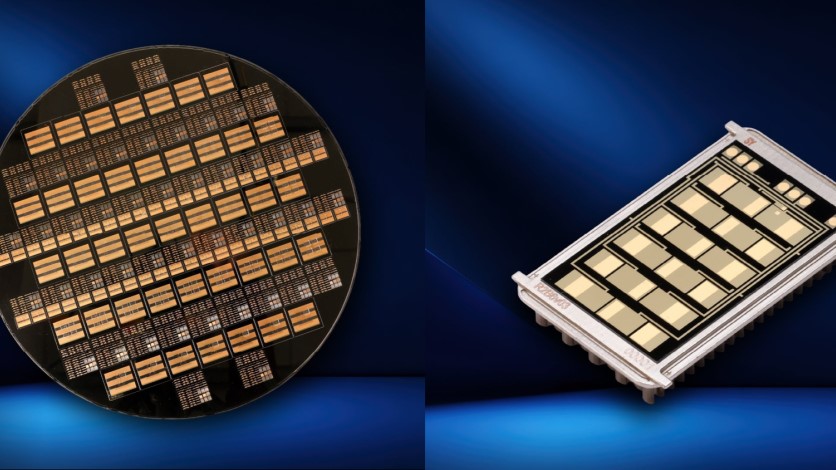
onsemi EPP uses 12-inch silicon wafers to package SiC/GaN power chips, eliminating wire bonding. It cuts AI breaker size 50% and EV loss 15%.
onsemi EPP Platform: Reconstructing Power Packaging Architecture with 12-Inch Silicon Wafers