
Mastering Wireless Connectivity with Receiver Chips
2025-02-25
With the rapid development of wireless communication technologies, wireless consumer electronics have become an indispensable part of modern life. From wireless headphones to smart home devices and wearable technology, these products all rely on high-performance wireless receiver chips to achieve stable and efficient data transmission. This article will provide a detailed introduction to the principles, characteristics, and application areas of wireless receiver chips, and offer reference for chip selection by examining several popular models.
Introduction to Wireless Receiver Chips
Wireless receiver chips are a core component of wireless communication systems, primarily responsible for receiving wireless signals and demodulating them into processable digital signals. Their operation involves key steps such as the modulation and demodulation of RF signals, spectrum analysis, signal amplification, and filtering. The performance of wireless receiver chips directly affects the communication capabilities and user experience of devices, making their design and selection crucial.
A typical wireless receiver chip consists of an RF front end, intermediate frequency (IF) processing module, baseband demodulation module, and digital signal processing module. For example, the RTC6711 includes a low-noise amplifier (LNA), mixer, ADC/DAC, microcontroller unit (MCU), and storage module. These components work together to receive, amplify, down-convert, demodulate, and process data.
Moreover, the performance of wireless receiver chips mainly depends on the following key characteristics:
- Frequency Range: Common wireless frequency bands include the 2.4GHz ISM band (e.g., Bluetooth, Wi-Fi), 433MHz, 868MHz, and 915MHz.
- Data Rate: Ranging from low-speed 10Kbps (e.g., HS0829) to high-speed 2Mbps or higher.
- Power Consumption: Low-power design is crucial for battery-powered devices. For example, the power consumption of the XL2400P in receive mode is only 12.3mA.
- Receiver Sensitivity: High-sensitivity chips can operate normally at lower signal strengths. For example, the receiver sensitivity of the RTC6711 can reach -90dBm.
- Package Form: Small packages such as SOP8 and QFN20 facilitate integration into compact consumer electronics.
Application Scenarios of Wireless Receiver Chips in Consumer Electronics
Wireless receiver chips are widely used in various wireless consumer electronics. Here are some typical application scenarios:
- Smartphones and Tablets
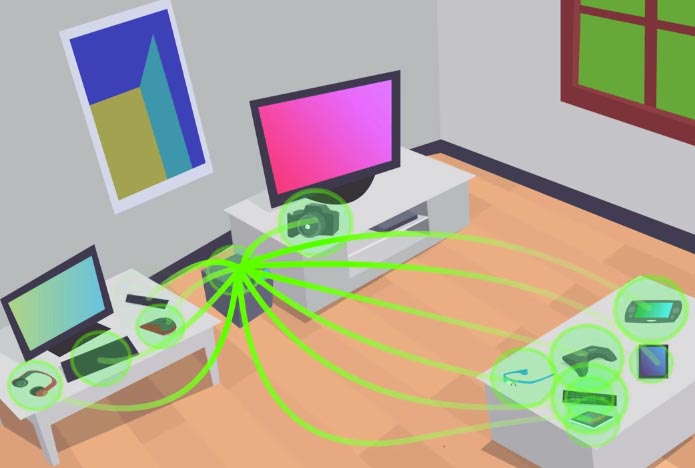
- 5G/Wi-Fi 6E Integration: Multi-band receivers (eg., Sub-6GHz + mmWave) enable high-speed data transmission.
- Satellite Communication: L band receivers support internet access in emergency situations.
- Beacon Positioning: UWB chips (eg., Decawave DW3000) provide centimeter-level indoor positioning.
- TWS Headphones and Smartwatches
- Bluetooth 5.3 Low Power: TI CC2652B supports wireless streaming between dual earbuds with a 30% reduction in power consumption.
- Multi-point Connection: Qualcomm QCA9377 chip enables a single device to connect to four audio devices.
- Health Monitoring: Integrated PPG sensors and wireless transmission modules.
- Smart Home and IoT Devices
- Matter Protocol Compatibility: Silicon Labs EFR32 series supports unified multi-standard communication.
- LoRa Long-range Transmission: Semtech SX1278 receivers achieve long-range networking up to 10km.
- Zigbee Mesh Network: NXP JN5182 chips build self-healing wireless sensor networks.
- Emerging Wearable Devices
- Bone Conduction Communication: AfterShokz open platform integrates Bluetooth 5.2 receiver modules.
- AR/VR Spatial Positioning: UWB chipsets (e.g., NXP DW3000+DW3001) enable 6DoF tracking.
Selection Guide for Popular Wireless Receiver Chips
The following table compares several popular wireless receiver chips to facilitate selection by designers:
| Chip Model | Frequency Range | Modulation Method | Data Rate | Receiver Sensitivity | Power Consumption | Application Scenarios |
| Si24R1 | 2.4GHz ISM | GFSK/FSK | 2Mbps/1Mbps/250Kbps | -83dBm@2MHz | Receive current 15mA | Wireless mice, keyboards, smart home |
| RTC6711 | 2.4GHz | Multiple modulation methods | 2Mbps | -90dBm | Low power | Wireless communication devices |
| XL2400P | 2.4GHz | GFSK | 125Kbps/250Kbps/1Mbps/2Mbps | -96.5dBm | Receive current 12.3mA | Smart home, wireless keyboards/mice |
| HS0829 | 300MHz~450MHz | ASK/OOK | 10Kbps | -113dBm | Low power | Wireless remote control devices |
Conclusion
Wireless receiver chips play a vital role in modern wireless consumer electronics. From ultra-high-speed connections in smartphones to precise interactions in wearable devices, the synergy between high-performance receiver chips and innovative applications will drive the deep penetration of wireless communication technologies in the fields of Industry 4.0 and smart cities. By understanding the characteristics and application scenarios of different chips, designers can better select suitable chips. Meanwhile, engineers should consider factors such as frequency band compatibility, power consumption budget, protocol support, and ecosystem maturity when selecting chips to build optimal solutions.
Email: info@semicone.com
Samsung Electro-Mechanics' Strategic Shift: Exiting the HDI Smartphone Mainboard Market
MAX326xx Series of Embedded Solutions: Comprehensive Analysis and Application Guide
Related Article
NVIDIA prepays KYEC to secure US testing capacity. KYEC and its AeternZ subsidiary will build the capacity, repayment offsets future service fees.
NVIDIA Prepayment Lock KYEC's US Testing Capacity
Microchip acquired VORAGO and Hailo. VORAGO adds HARDSIL tech, Hailo brings 26 TOPS processors. Both deals closed in 2026.
Microchip's Two Acquisitions: Aerospace & Defense and Edge AI

