Clock Timing ICs: A Comprehensive Guide
2024-09-29
Clock Timing IC Definition and Function
A clock timing integrated circuit (Clock Timing IC) is a pivotal component in electronic systems, specifically designed to generate, distribute, and control precise clock signals. Serving as the "heartbeat" of electronic devices, it provides a unified and stable time reference for all functional modules, ensuring their synchronized operation. The clock signal, a periodic electrical pulse, directly influences the system's operating speed and efficiency, underpinning critical operations like data synchronization and instruction execution.
 Clock/Real-Timing IC Working Principle
- Oscillation Source: The core of a clock IC is its internal oscillation source, typically a quartz crystal oscillator or a ceramic resonator. These oscillators exhibit exceptional frequency stability, generating the raw clock signal. This signal then undergoes processes like frequency division and multiplication to meet the specific frequency requirements of various modules.
- Frequency Division and Multiplication: To accommodate the diverse clock frequency needs within a system, clock ICs incorporate precision frequency dividers and multipliers. Dividers reduce high-frequency clock signals into lower frequencies for modules requiring slower clock rates, while multipliers increase low-frequency signals to higher frequencies for high-speed modules.
- Clock Distribution: The generated clock signal is efficiently distributed to all system modules through buffers. Buffers enhance the signal's driving capability, ensuring it remains robust and stable over long transmission distances.
- Clock Synchronization: In systems with multiple clock sources, the clock IC synchronizes these sources using advanced techniques like phase-locked loops (PLLs) or delay-locked loops (DLLs), ensuring coherent operation and preventing timing-related issues.
Technical Characteristics
- High Precision: Modern clock ICs offer unprecedented frequency stability, with precision levels reaching parts per million (ppm) or even parts per billion (ppb), guaranteeing accurate and reliable system operation.
- Low Jitter: Jitter, or the uncertainty in the timing of a signal's edges, can compromise system stability. Low jitter is a hallmark of high-performance clock ICs and enhances data transmission accuracy and efficiency.
- Low Power Consumption: With the proliferation of portable devices, low power consumption is a crucial consideration in clock IC design. This extends battery life and improves user experience.
- High Integration: To meet the demands of complex systems, modern clock ICs integrate multiple functions, such as PLLs, DLLs, and real-time clocks (RTCs), simplifying system design and reducing costs.
Application Areas
The application range of clock ics is extremely wide, covering almost all electronic systems requiring accurate time control. From the CPU, memory and peripherals in the computer system to the base station, router and switch in the communication equipment; From consumer electronics such as smart phones, tablets, smart watches, to industrial control systems in the PLC, inverter; Even in the field of automotive electronics and aerospace, clock ics play an irreplaceable role.
Take smart phones as an example, their internal integrated clock IC not only controls the working frequency of core components such as CPU and GPU, but also is responsible for the refresh rate adjustment of the display screen, the synchronization of audio playback and the timing control of data processing. In network equipment and automotive electronic systems, the clock IC also plays an indispensable role in ensuring the accuracy of data transmission and the safety of vehicle operation.
Clock IC Selection Guidelines
Choosing the right clock IC is very important for system design. In the selection, need to consider a number of factors. According to the specific needs of the system and the working environment, choosing the most appropriate clock IC is crucial to ensure the stable operation of the system.
- Frequency range: Ensure the clock IC's frequency range meets system requirements.
- Output count: Choose the appropriate number of output channels based on the number of system modules.
- Phase noise and jitter: Select a clock IC with phase noise and jitter levels that meet application requirements.
- Power consumption: Prioritize low power consumption while maintaining performance.
- Operating temperature range: Ensure the clock IC can operate within the system's temperature range.
Trending and Conclusion
Future clock ICs will continue to evolve towards higher frequencies, lower power consumption, higher integration, and improved resistance to interference. As processor speeds increase and electromagnetic environments become more complex, these characteristics will be essential.
Clock timing integrated circuits are indispensable components in modern electronic systems. Their continuous evolution and expanding application areas underscore their significance. A deep understanding of clock ICs, including their working principles, technical characteristics, and selection guidelines, is essential for designing high-performance and reliable electronic systems.
Buy Clock/Timing IC in Semicone Stores
| M41T62Q6F |
Real-time clock (RTC) chip
It is primarily used to provide time and/or date information for almost any electronic device that needs to keep accurate time
Features include clock/calendar function, alarm function, 32 KHz output, calibration, and watchdog function
|
| TRF3750IPW |
Integer-N PLL frequency synthesizer designed for wireless transceivers
Capable of covering frequencies up to 2.4 GHz
Dual supply range: 3 V-3.6 V and 4.5 V-5.5 V
Separate Charge Pump Supply (VCP) up to 8 V
Simple 3-wire serial interface allows for fully programmable A, B, and R counters, dual modulus prescaler, and charge pump current
Lock Detect Output (Digital and Analog)
|
| TS555CN |
Single CMOS timer offered by ST, whcih direct replacement for the NE555 timer ic
Typically 100µA at 5V supply
High maximum astable frequency of 2.7MHz
Operates over a wide voltage range of +2V to +18V
Provides reduced supply current spikes during output transitions, allowing for the use of smaller decoupling capacitors
|
Email: info@semicone.com
Micron Technology: A History of Innovation and Growth
Vishay Undergoes Massive Restructuring: 800 Job Cuts, 3 Factories to Close
Related Article
US memory race: Micron builds Idaho & NY fabs for DRAM/HBM4. SK hynix builds Indiana packaging for HBM.
U.S. Memory Chip Manufacturing: The Capacity Race Between Micron and SK hynix
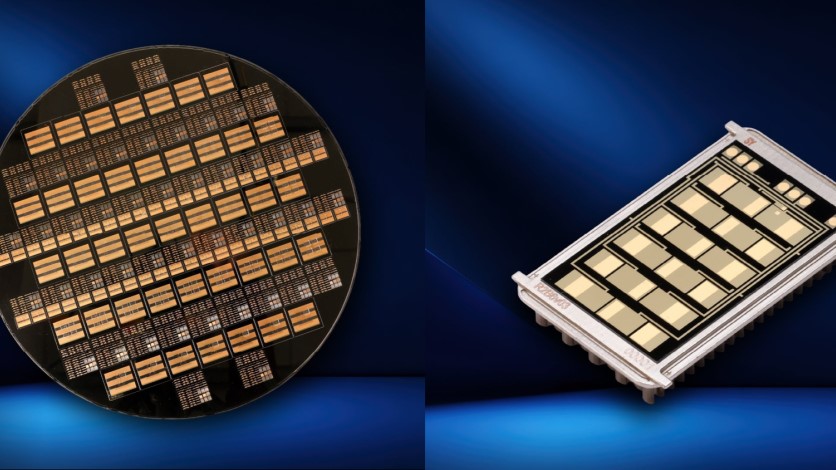
onsemi EPP uses 12-inch silicon wafers to package SiC/GaN power chips, eliminating wire bonding. It cuts AI breaker size 50% and EV loss 15%.
onsemi EPP Platform: Reconstructing Power Packaging Architecture with 12-Inch Silicon Wafers