
Global Industrial Robots Strategy: U.S. Specializes, China Expands
2025-05-23
The United States has long been a leader in automotive automation, with a significant increase in the installation of industrial robots in this sector. According to preliminary results from the International Federation of Robotics (IFR), the total number of industrial robots installed in the U.S. automotive industry grew by 10.7% in 2024, reaching 13,700 units. This growth underscores the U.S.'s commitment to maintaining a highly automated automotive manufacturing sector, which ranks fifth globally in terms of the ratio of robots to factory workers, alongside Japan and Germany.
However, this focus on automotive automation has led to a "specialization" that leaves the U.S. trailing behind in other key areas of manufacturing automation. While the automotive industry benefits from advanced robotic technology, other sectors are not seeing the same level of investment and development.
Global Robot Production Dynamics
Despite its advanced automotive automation, the U.S. relies heavily on imported industrial robots, as there are very few domestic robot manufacturers. In fact, 70% of the world's industrial robots are produced in just four countries: Japan, China, Germany, and South Korea. Among these, Chinese manufacturers have shown remarkable growth and dynamism.
China's domestic market has seen a threefold increase in robot production over the past five years (2019-2023), making it the second-largest producer globally, just behind Japan. This rapid growth is largely attributed to China's national robotics strategy, which has driven significant investment and development in the sector. Between 2021 and 2023, China installed approximately 280,000 industrial robots annually in its manufacturing sector, compared to the U.S.'s 34,300 installations in 2024.
China's Comprehensive Robot Penetration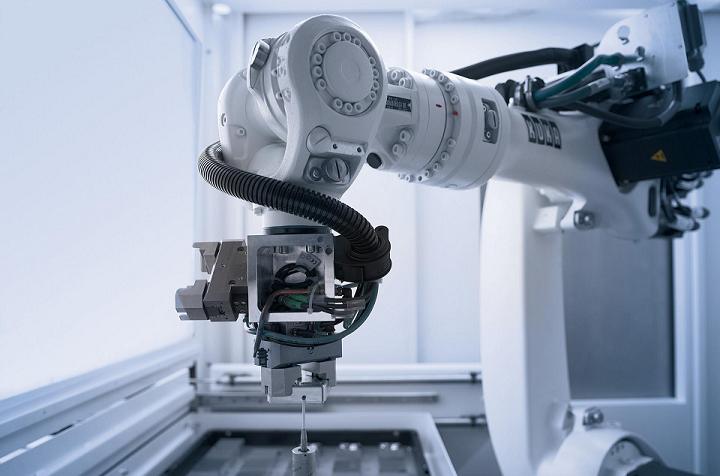
China's approach to robot technology and automation is characterized by its comprehensive penetration across various production sectors, not just automotive. The country's robot density in manufacturing reached 470 robots per 10,000 employees in 2023, surpassing Germany and Japan to rank third globally, behind only Korea and Singapore. This widespread adoption of robots reflects China's strategic push to integrate automation into every aspect of manufacturing, enhancing efficiency and productivity.
U.S. Market Dynamics and Sectoral Focus
In contrast, the U.S. ranks tenth globally in terms of automation levels in manufacturing, with 295 robots per 10,000 employees. The majority of new industrial robot installations in the U.S. are concentrated in the automotive sector, accounting for about 40% of all installations in 2024. The metal and machinery sector follows with 3,800 installations (11% market share), while the electrical and electronics sector installed 2,900 units (9% market share).
This sectoral focus highlights a strategic difference between the U.S. and China. While the U.S. prioritizes automotive automation, China has adopted a more holistic approach, integrating robots into a broader range of industries. This strategy allows China to benefit from automation across multiple economic sectors, potentially leading to more balanced and widespread industrial development.
Conclusion
The global landscape of industrial robot adoption reveals distinct strategies between the U.S. and China. While the U.S. excels in automotive automation, China's comprehensive approach to integrating robots across various sectors positions it for broader industrial advancement. As both countries continue to invest in automation, the future of global manufacturing will likely be shaped by these differing approaches, with China's rapid growth and the U.S.'s specialized focus each contributing to the evolving dynamics of the industry.
Semicon IC Distributor and Popular IC Models
Semicon is a leading distributor of high-quality integrated circuits (ICs), offering a wide range of products for various applications. Here are some popular chip models:
- TMP36GRTZ-REEL7: A precision temperature sensor with a linear output, ideal for applications requiring accurate temperature monitoring.
- AM26LV31EIRGYR: A high-speed, bidirectional bus transceiver designed for reliable data transmission in industrial and communication systems.
- MP28167GQ-A-Z: A high-efficiency switching regulator with built-in protection features, suitable for power management in consumer electronics.
- NTS4001NT1G: A low-noise, high-precision operational amplifier, perfect for sensitive analog signal processing applications.
Email: info@semicone.com
In-Depth Analysis of ADI's Top 5 Popular IC Models
Microchip Cuts Prices of PolarFire FPGA and SoC by 30%
Related Article

AMD Acquires Taalas. "Model-as-Chip" architecture hardens weights in silicon, challenging GPU dominance with specialized, ultra-efficient MSICs.
AMD Acquires Taalas: Reshaping the AI Inference Landscape

Tiny yet critical: resistors evolve from commodity to high‑performance solutions. Market hits $8.3B in 2026, with miniaturization, automotive-grade AEC-Q200, and localization reshaping the competitive landscape.
Tiny Component Resistor: Principle, Trends, and Key Suppliers