Humanoid Robots on the Rise: A New Catalyst for the Semiconductor Sector
2025-02-10
Humanoid robots, as an integral part of intelligent service robots, are considered a significant direction for future robotic development due to their close resemblance to human form and behavior. In recent years, with the rapid advancement of artificial intelligence (AI) technology, humanoid robots have gradually transitioned from laboratories to the market, becoming a hot topic in the tech field. Projects such as Tesla's Optimus, Figure AI supported by OpenAI, and the humanoid robots from Unitree Technology have all made breakthroughs, accelerating the commercialization and mass production of humanoid robots.
Global Status of the Humanoid Robot Industry
The global humanoid robot market is currently in a phase of rapid development. According to data from the High-Work Research Institute, the global market size for humanoid robots is projected to reach $10.17 billion in 2024 and is expected to soar to $151.42 billion by 2030, with a Compound Annual Growth Rate (CAGR) of 56.85%. Tesla plans to start small-scale production of its Optimus humanoid robot in 2025 and expand its production capacity to 100,000 units per year by 2026. Numerous companies, both domestic and international, are actively positioning themselves in the humanoid robot industry chain, including Huawei, ByteDance, BYD, and Boston Dynamics. The application scenarios for humanoid robots are also expanding, from industrial tasks like factory transportation and sorting to potential future roles in home services and medical care.
In addition, technological innovations are continuously advancing. From a technical standpoint, AI has made significant progress, enabling the integration of multimodal large models to enhance robots' generalization capabilities in complex task scenarios. There has also been a substantial improvement in locomotion capabilities, with breakthroughs in bio-inspired joint torque density and the development of all-terrain adaptive algorithms. Furthermore, the development of core components such as high-power motors, high-performance chips, and precision reducers has established a more stable and high-performance hardware system for humanoid robots.
How the Popularity of Humanoid Robots Drives Semiconductor Development
The rapid development of humanoid robots presents significant opportunities for the semiconductor industry. As highly complex technological products, humanoid robots require a large number of high-performance semiconductor chips to achieve functions in motion control, perception, decision-making, and more. With the swift growth of the humanoid robot market, the semiconductor industry is poised to enter an unprecedented phase of development.
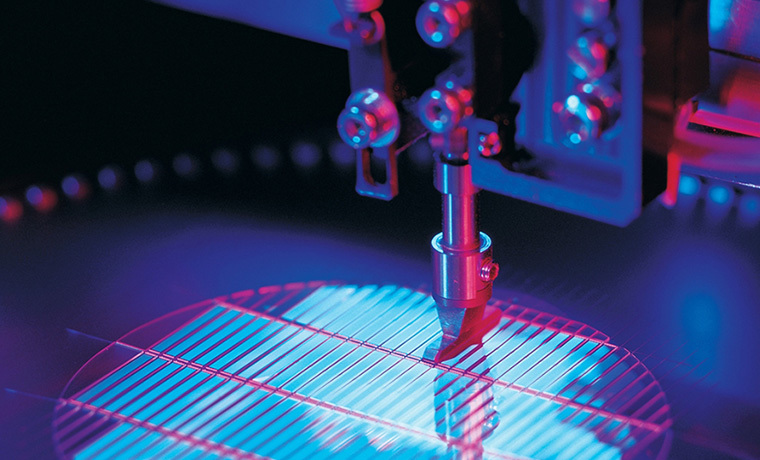 Specifically, Gallium Nitride (GaN) chips are emerging as a new opportunity. Taking Tesla's Optimus humanoid robot as an example, it is equipped with 28 joint actuators, each of which requires 1-2 power semiconductor chips (such as IGBTs) to drive the motors. However, given that motor power typically ranges from 1kW to 3kW, there are strict requirements for the current conduction capability and low internal resistance of power devices. Compared to traditional silicon-based power devices, GaN chips offer higher electron mobility, breakdown field, and thermal conductivity, enabling them to operate at higher frequencies and voltages while reducing conduction resistance and switching losses. This enhances motor efficiency and performance, reduces energy loss and cooling demands, and with the growth of the humanoid robot market, the demand for GaN chips is expected to surge, presenting a broad prospect for the industry.
The Microcontroller Unit (MCU) market is also experiencing growth. For instance, Optimus has approximately 40 degrees of freedom, each of which requires an MCU to precisely control the robot's joints, sensors, and actuators. A single humanoid robot typically needs 30-40 MCUs. Moreover, as robots enter mass production and undergo iterative upgrades, their movements will more closely mimic human actions, placing higher demands on the performance and quantity of MCUs. The need to process large amounts of sensor data and respond quickly will drive a continuous increase in the usage of mid-to-high-end MCUs, expanding the market size.
In addition to GaN chips and MCUs, other chip categories such as AI chips, sensor chips, and power device chips also hold development opportunities in the field of humanoid robots. For example, AI chips can support intelligent perception, decision-making, and interaction in robots. With the increasing demand for intelligent interaction in humanoid robots, the market demand for AI chips is expected to grow accordingly. Sensor chips can provide environmental perception information for humanoid robots, ensuring their accurate operation.
Conclusion
The rapid development of humanoid robots is becoming a new engine for the growth of the semiconductor industry. From power semiconductors to microcontrollers, from sensors to storage chips and SoCs, the increasing demand for semiconductor chips by humanoid robots is creating new growth points for the semiconductor industry. As humanoid robot technology continues to mature and the market expands, the semiconductor industry will face both more opportunities and new challenges. In the future, it is anticipated that the mutual promotion and common development of humanoid robots and the semiconductor industry will bring more convenience and innovation to people's lives.
Humanoid Robot Chip Semiconductor Parts
Semicone Electronics is a dedicated distributor of electronic IC semiconductors. Now we are pleased to share with some popular Humanoid Robot IC components that could enhance your electronic design project.
- The AD7606BSTZ is a high-performance, 16-bit analog-to-digital converter (ADC) with eight channels, designed for precision and efficiency. It features a sampling rate of up to 200 kSPS, true bipolar input ranges of ±10V and ±5V, and low power consumption of only 100 mW. This ADC includes built-in protection circuits, anti-aliasing filters, and a flexible digital interface compatible with SPI and other protocols.
- The ULN2803ADWR is a high-voltage, high-current Darlington transistor array designed for driving inductive loads such as relays, solenoids, and motors. It features eight NPN Darlington pairs with built-in suppression diodes to protect against voltage spikes, and each channel can handle up to 500 mA of current.
- The LAN8720A-CP-TR is a low-power, single-chip 10BASE-T/100BASE-TX Ethernet physical layer (PHY) transceiver with a variable I/O voltage range of 1.6V to 3.6V, supporting both IEEE 802.3-2005 compliant and vendor-specific register functions. It features a 24-pin QFN package, HP Auto-MDIX support for direct or crossover LAN cables, and various low-power modes.
- The MCIMX6G2CVM05AB is a high-performance, quad-core ARM Cortex-A9 processor from NXP Semiconductors, featuring up to 1.2 GHz processing speed, integrated GPU for graphics acceleration, and support for various multimedia interfaces, making it ideal for embedded systems in industrial, automotive, and consumer electronics applications.
Email: info@semicone.com
Detailed Explanation and Development Trends of Motor Drivers Chips
South Korean Chip Giant Magnachip Seeks to be Sold Again
Related Article

Marvell will acquire Lumentum in a $115B all-stock deal to combine electrical and optical interconnect for AI data centers, targeting 2028 close.
Optical Interconnect: Marvell's $115 Billion Acquisition of Lumentum

Yageo plans a 10–15% MLCC and tantalum capacitor capacity increase by 2027, keeping utilization at 85–90% as AI demand tightens high-end supply and lead times stretch.
Yageo to Add 10% Capacity: Passive Component Expansion