Understanding ADC and DAC: The Essential Components of Signal Conversion
2025-01-09
In the realm of electronics and digital signal processing, two fundamental components play a crucial role in signal conversion between the analog and digital domains: Analog-to-Digital Converter (ADC) and Digital-to-Analog Converter (DAC). They act as bridges in the signal processing process, connecting the analog world with the digital world, enabling smooth information exchange and processing between the two.
Analog-to-Digital Converter: The Bridge to the Digital Domain
An Analog-to-Digital Converter (ADC) is a device that converts analog signals, such as voltage or current, into a digital representation that can be processed by computers or other digital systems. This conversion is essential because many signals in the real world exist in analog form, such as sound, temperature, and pressure, which are continuous in size and change. However, modern electronic systems are predominantly based on digital technology for processing and transmission. Therefore, ADCs are needed to convert these continuous analog signals into discrete digital signals, allowing computers or other digital devices to recognize and process them.
The ADC process involves two main steps: sampling and quantization. The ADC first samples the analog signal, measuring its instantaneous voltage or current value at specific time intervals. According to the Nyquist theorem, to avoid aliasing, the sampling frequency should be at least twice the highest frequency of the signal. Next, the continuous voltage or current values obtained from sampling are converted into a finite number of discrete values. This quantization process includes assigning a digital code to each level, effectively converting the analog signal into a digital format. The number of bits used for quantization determines the ADC's resolution; a higher bit resolution provides a more accurate representation of the analog signal. Finally, the quantized discrete values are converted into binary or other forms of digital encoding for further processing and storage by the digital system.
ADCs are ubiquitous in modern electronic products, from audio interfaces and digital cameras to medical devices and industrial control systems. For example, in audio equipment, ADCs convert the analog sound signals captured by microphones into digital signals for audio editing and storage. In the field of industrial automation, sensors collect analog signals such as temperature and 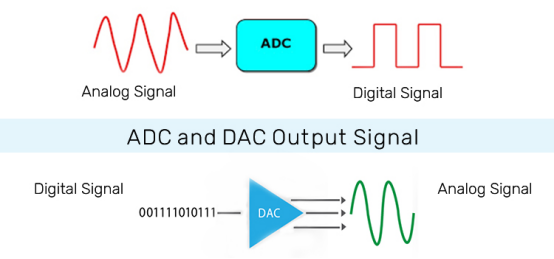 pressure, which are then converted into digital signals by ADCs for data analysis and decision-making by control systems.
 pressure, which are then converted into digital signals by ADCs for data analysis and decision-making by control systems.
Digital-to-Analog Converter: The Bridge Back to the Analog World
Conversely, a Digital-to-Analog Converter (DAC) performs the opposite function of an ADC. A DAC is an electronic device that converts digital signals into analog signals. Digital signals processed in digital systems often need to be output in analog form or used to drive other analog devices, requiring DACs to restore digital signals to analog signals, achieving seamless integration between the digital and analog worlds.
The DAC process involves converting digital bits into corresponding voltage or current levels. The digital input is typically a binary number, with each bit assigned a specific weight or voltage level. Then, the DAC sums these weighted voltages to produce the desired analog output signal. Like ADCs, DACs also have considerations regarding resolution. The number of bits in the digital input determines the DAC's resolution; higher resolution results in a smoother and more accurate analog signal. However, it is important to note that the quality of the analog output is also affected by the design and components used in the DAC.
DACs are widely used in audio devices, such as CD players and digital audio workstations, converting digital audio signals back into analog sound waves that can be heard through speakers or headphones. They are also used in video displays, control systems, and various other applications that require the conversion of digital data into analog form. For instance, in the high-end audio market, DAC chips employing Sigma-Delta technology have become the mainstream choice due to their advantages of large dynamic range and low noise.
The Importance of ADCs and DACs
ADCs and DACs play a vital role in modern electronic systems, acting as bridges between the analog and digital worlds. Without ADCs and DACs, digital systems would be unable to directly process analog signals from the real world or output processed digital signals in analog form, greatly limiting the scope of electronic technology applications. With technological advancements, high-precision, high-sampling-rate ADCs enable more accurate and complete signal acquisition, providing a reliable foundation for data analysis and processing. Meanwhile, high-performance DACs ensure more realistic and stable signal reconstruction, meeting the stringent requirements for signal output quality. Additionally, ADCs and DACs have facilitated the integration of different industries. For example, in the smart home sector, they allow sensor data to be processed by intelligent control systems and drive related devices, bringing new opportunities and momentum to economic development.
Future Development Trends
In the future, ADC and DAC technologies will continue to evolve towards higher precision and speed to meet the growing demands of signal processing. High-precision ADCs can capture subtle changes in signals more finely, suitable for precision measurement and complex signal processing. High-speed ADCs and DACs can handle wider frequency band signals, adapting to applications in high-speed communication and real-time signal processing. At the same time, with the advancement of integrated circuit technology, ADCs and DACs will become more integrated and miniaturized, potentially being integrated with other functional modules on a single chip to form System on Chip (SoC), reducing the system's size and power consumption, and enhancing the system's integration and portability. Moreover, ADCs and DACs may acquire intelligent and adaptive capabilities, automatically adjusting parameters based on signal characteristics and environmental changes, and combining with artificial intelligence algorithms to achieve more complex signal processing functions, providing smarter solutions for electronic systems.
Semicon DAC/ADC Solutions
Are you looking for a suitable IC solution provider? SEMICON is a semiconductor distributor that offers a broad range of IC products to meet customers' specific electronic needs. If you need IC components or related details, contact Semicone. Here are some popular ADC and DAC products.
- The DAC7612U is a dual-channel, 12-bit digital-to-analog converter (DAC) with 12-bit guaranteed monotonicity over the industrial temperature range. It is powered by a +5V single supply, with a built-in input shift register, latch, 2.435V reference voltage source, a dual-channel DAC and high-speed rail-to-rail output amplifier.
- The ADS1110A0IDBVR is a low-power, high-precision analog-to-digital converter (ADC) manufactured by TI. Its low-power design and multiple operating modes with operating voltages ranging from 2.7V to 5.5V make it particularly suitable in battery-powered portable devices.
- The AD9650BCPZ-105 is a dual-channel, 16-bit, 25 MSPS/65 MSPS/80 MSPS/105 MSPS analog-to-digital converter (ADC) designed to digitize high frequency, wide dynamic range signals with input frequencies up to 300 MHz.
Email: info@semicone.com
$900 Million! NXP Acquired TTTech Auto and AvivaLinks Within a Month
The Intense Competition in 2nm Process Tech: Delays, Order Transfers, and Multi-Party Rivalry
Related Article

Current sense amplifiers turn tiny shunt-resistor drops into precise voltage outputs. Learn high/low-side sensing, key specs, and top CSA models.
Current Sense Amplifier: A Complete Guide from Principles to Selection

Resonac unveils Japan's first 12-inch SiC substrate, delivering 4x the chip output of 6-inch wafers. AI server cooling and AR waveguides are key targets.
Power Semiconductor Materials: Resonac's 12-Inch SiC Substrate