Ford Enters Battery Business with CATL-Licensed LFP Batteries
2026-11-19
On November 18 local time, Ford Motor announced a key milestone: the first batch of prismatic lithium iron phosphate (LFP) cells rolled off the production line at its BlueOval Battery Park in Michigan, USA. Manufactured under the technology license from CATL, these LFP cells will be shipped to the Louisville plant for integration into prototype Fathom electric pickup trucks. Ford will also become the first automaker to deploy LFP solutions in the mainstream U.S. passenger vehicle market.
Selection of the LFP Route
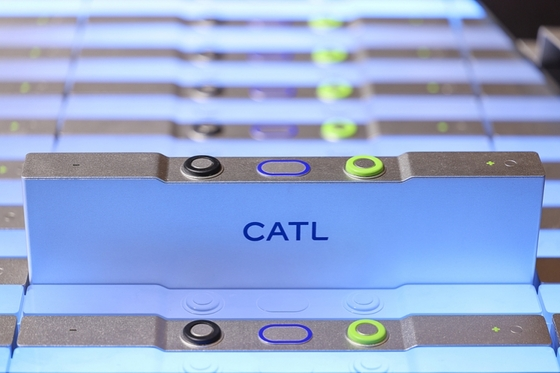 When selecting traction battery solutions, LFP batteries contain no precious metals such as nickel and cobalt. They feature controllable raw material costs and stable cycle life, making them inherently suitable for affordably priced models — this is the core reason behind Ford's adoption of this technical route. The cooperation follows a technology licensing model instead of direct procurement of finished cells. Ford retains operational control over the domestic U.S. production line, while CATL provides mature LFP manufacturing processes and technical systems.
The cell production line at BlueOval Battery Park can produce 40 cells per minute, ranking among the most efficient prismatic LFP production lines outside China. Equipped with an AI visual inspection system, the line maintains cell consistency during high-speed production. Ford's long-term target is to reduce cell defect rates to the parts-per-billion level to meet long-term vehicle reliability requirements. Cells produced at this stage are prioritized for prototype validation. Once the Marshall battery pack plant goes online later, cell encapsulation and BMS integration will be carried out to support the official launch of the Fathom model in 2027.
Domestic EV Battery Capacity Buildout in the United States
From an industrial perspective, this project marks an important step in building domestic traction battery capacity in the United States. Historically, electric vehicles in North America have relied heavily on external battery supplies, with scarce local LFP capacity. By adopting licensed technology, Ford has rapidly established production lines and shortened the development cycle for in-house battery technology. This initiative also builds up cell supply capacity for future energy storage businesses. Nevertheless, the project remains in the early validation phase. Continuous improvements are still needed for prototype testing, production yield ramp-up and supporting supply chain infrastructure.
Reference for Automotive Component Selection
Stable semiconductor components are required to support battery management, power conversion and on-board main control systems. Below is a list of widely used part numbers for battery pack and vehicle domain controller solutions. SEMICONE can be considered as a procurement source:
|
Part Number
|
Device Type
|
Typical Application
|
|
Temperature Sensor
|
Multi-point temperature sensing and thermal management monitoring for battery packs
|
|
|
Step-Down Power IC
|
Power conversion for BMS and domain controller boards
|
|
|
MCU Microcontroller
|
Main battery management control and automotive peripheral control
|
|
|
Zynq FPGA
|
High-speed battery data acquisition and real-time algorithm processing
|
|
|
Gate Driver IC
|
Power inverter and bidirectional charge-discharge drive
|
Email: info@semicone.com
Mature-Node Foundry: Samsung to Manufacture STM32V8 for Starlink
Related Article
Samsung's $1.9B Austin expansion will produce STM32V8 for Starlink laser links by 2030, creating a second source for aerospace-grade FD-SOI MCUs.
Mature-Node Foundry: Samsung to Manufacture STM32V8 for Starlink

SK Hynix expands HBM4 capacity at Cheongju P&T6, focusing on bonding, dicing, and test equipment. Logic base die adds TSMC.
€3 Billion Boost: Tesla Expands Berlin Gigafactory for Cybercab