Unprecedented Wave of Automation, Global Factory Robot Density Doubled in seven Years
2024-12-02
In recent years, the global manufacturing industry has been undergoing an unprecedented automation revolution. According to the latest "World Robotics 2024" report published by the International Federation of Robotics (IFR), the robot density in global factories reached a historic high in 2023, with an average of 162 robots per 10,000 employees. This figure has more than doubled compared to 74 robots per 10,000 employees seven years ago. This trend not only demonstrates the strong demand for automation technology in the global manufacturing industry but also indicates the new direction of future manufacturing development.
01 Robot Density from a Global Perspective
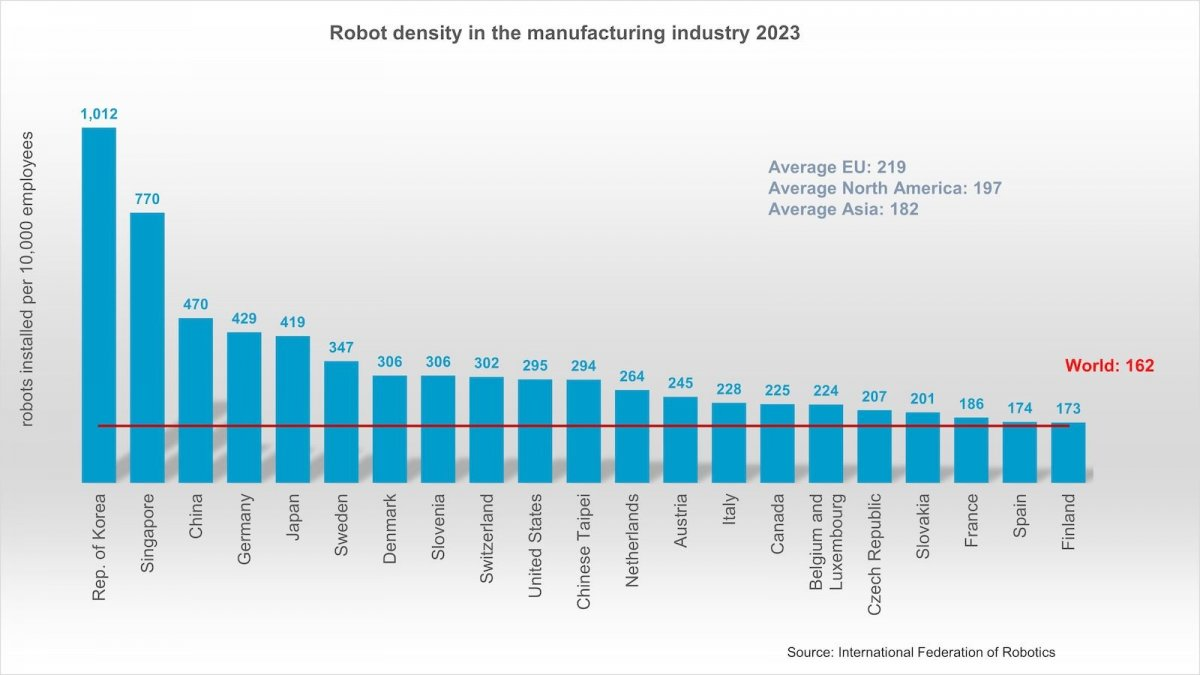
Globally, the growth in robot density has become an important indicator for measuring the level of automation in manufacturing industries across countries. In 2023, South Korea topped the list with a robot density of 1,012 robots per 10,000 employees, making it the country with the highest industrial robot application density worldwide. This is attributed to South Korea's robust development in the electronics and automotive industries, which have a huge demand for industrial robots, driving the rapid growth of robot density in the country.
Following closely behind is Singapore, whose performance in robot density is also impressive. With a configuration of 770 robots per 10,000 employees, Singapore ranks among the top globally. Despite having a relatively small number of manufacturing employees, Singapore has achieved a high robot density through efficient industrial automation applications.
Meanwhile, China's performance in this field cannot be overlooked. In 2023, China surpassed Germany and Japan for the first time with a configuration of 470 robots per 10,000 employees, ranking third globally. This is due to China's significant investments in automation technology in recent years, which have paid off and driven the rapid growth of robot density in the country.
02 Regional Distribution and Growth Trends
Regionally, the European Union (EU) has the highest robot density, reaching 219 robots per 10,000 employees, with a 5.2% increase compared to 2022. Among them, Germany, Sweden, Denmark, and Slovenia stand out in robot applications, all ranking among the top ten globally. These countries have a high level of manufacturing automation, driving the rapid growth of robot density.
North America follows closely behind, with an average of 197 robots per 10,000 employees, up 4.2% from 2022. Although the United States' robot density did not rank in the top ten globally, its investment in automation continues to increase. However, compared to the growth trends in other regions worldwide, the United States' robot density growth is relatively slow, reflecting its lag in the automation process.
The robot density in Asian manufacturing is 182 robots per 10,000 workers, with a 7.6% increase. Besides South Korea and Singapore, China and Japan also have high robot densities in Asia. These countries have achieved significant results in promoting manufacturing automation, injecting new momentum into the development of the manufacturing industry in Asia.
03 Driving Forces Behind Robot Density Growth
 The rapid growth in robot density is driven by multiple factors. Firstly, the increasing demand for automation technology in the global manufacturing industry has fueled the rapid development of the robot market. With rising labor costs and intensifying market competition, more and more companies are adopting automation technology to improve production efficiency and reduce costs.
Secondly, the support and investment of governments in automation technology have also played an important role. Many countries have formulated policies to encourage enterprises to adopt automation technology and promote the transformation and upgrading of the manufacturing industry. The implementation of these policies has provided strong support for the rapid development of the robot market.
Furthermore, the continuous advancement of robot technology has also provided powerful support for the growth in robot density. With the continuous development of artificial intelligence, deep learning, and other technologies, robots have become more intelligent, and their application scenarios have become increasingly diverse. This has prompted more and more companies to consider adopting robots to replace traditional human labor.
04 Future Outlook
Looking ahead, the robot density in global factories is expected to continue to grow. With the continuous development and expansion of automation technology, robots will play an increasingly important role in the global manufacturing industry. At the same time, governments will continue to increase their support and investment in automation technology to promote the transformation, upgrading, and high-quality development of the manufacturing industry. However, while promoting the growth in robot density, it is also necessary to pay attention to social issues such as changes in employment structure. Balancing the relationship between automation development and employment security will be an important issue to face in the future.
In conclusion, the robot density in global factories has doubled in seven years. This trend not only reflects the strong demand for automation technology in the global manufacturing industry but also indicates the new direction of future manufacturing development. In future development, we need to continue to pay attention to the growth trend of robot density and promote the widespread application and high-quality development of automation technology.
Hot Automation Chips: Explore Semicon Distributor
Semicon Electronics is a dedicated distributor of semiconductor components, committed to providing high quality products and outstanding service. Semcione's main products include microcontrollers, sensors, connectors, pmic, controllers, relays, and more.
-
The EN5339QI is an efficient synchronous buck DC-DC converter from Intel. Advanced constant frequency current mode PWM control technology can provide up to 3A output current over a wide input voltage range. The current mode control and current suppression technology can effectively suppress the output ripple and noise, and provide a clean and stable output voltage.
-
The OPA2604AU is a high performance operational amplifier from TI that performs well in audio and other noise sensitive applications. It is able to provide high gain over a wide frequency range, help maintain the fidelity of the signal, and has a good response to rapidly changing signals.
-
The XC3S700A-4FGG484I is a field programmable gate array (FPGA) chip produced by Xilinx Corporation and belongs to the Spartan-3AN family. The XC3S700A-4FGG484I is highly programmable, allowing users to flexibly configure and program according to their specific needs. It also has high-speed data transmission and processing capabilities to handle large amounts of data and meet the needs of high-speed applications. At the same time, the chip supports up to 288 18× 18-bit multipliers with powerful DSP capabilities.
Email: info@semicone.com
Arm Leading the AI Future: Driving Computational Subsystems, Targeting 100 Billion AI-Enabled Devices
Semiconductor Analog IC Leader: Analog Devices (ADI)
Related Article

Korea's Supreme Court upholds a KRW 18.66B fine on Broadcom for abusing its market position and forcing Samsung into a long-term chip supply deal through cutoffs.
Broadcom's Korean Case Ends in Final Ruling: Supply Leverage Cannot Become a Tool of Coercion

NXP issues its third 2026 price hike, effective January 1, 2027, without disclosing increases or part lists, as costs and lead times stretch and industry-wide price hikes continue.
NXP's Three Price Rounds in 2026: Increases, Part Numbers, and Cost Pressure