
Comprehensive Analysis of the AD8221 Instrumentation Amplifier Series by ADI
2025-02-14
Instrumentation amplifiers are essential core components in modern electronic measurement, industrial control, and medical equipment. Their primary function is to precisely amplify and condition the weak signals output by sensors while suppressing environmental noise and interference, thereby providing high-quality signals for subsequent data processing. In fields such as industrial automation, medical diagnostics, and scientific research, the performance of instrumentation amplifiers directly affects the accuracy and reliability of measurements.
Analog Devices, Inc. (referred to as ADI), a global leader in analog devices, holds a significant position in the analog chip market with its outstanding technology and extensive product line. In 2021, ADI's acquisition of Maxim Integrated further consolidated its leading position in the analog market. The AD8221 instrumentation amplifier series, as a classic product of ADI, has become a key device for meeting complex application requirements due to its high performance and flexibility, providing strong support for the development of various industries.
Comprehensive Insights into the AD8221 Series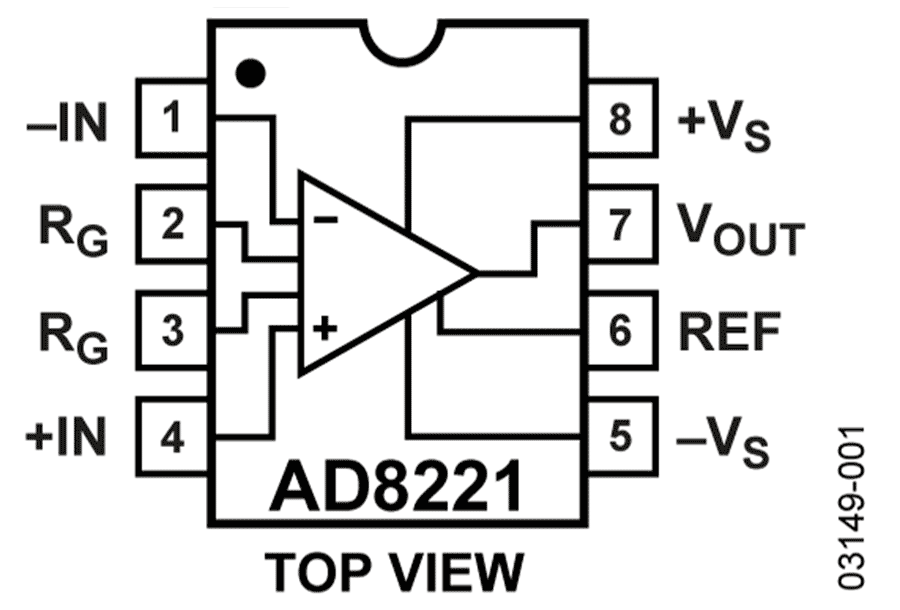
(1) Technical Principle Expansion
The AD8221 instrumentation amplifier is based on the principle of differential input. By amplifying differential signals, it effectively suppresses common-mode interference, enhancing the accuracy and stability of the signal. The device employs high-performance operational amplifiers and precision resistor networks internally to ensure low distortion and high accuracy during signal amplification. Additionally, through unique circuit design, it achieves high input impedance and low output impedance, minimizing signal loss during transmission and improving transmission efficiency.
(2) AD8221 Principle Expansion
- High Precision: The AD8221 features extremely low offset voltage and drift, maintaining signal accuracy and stability, and ensuring the reliability of measurement results over long-term use.
- Low Noise: Advanced noise filtering technology effectively reduces the impact of noise on signal measurement, providing clear and accurate signal amplification and processing. It maintains excellent performance even in weak signal detection.
- High Linearity: Good linearity ensures a linear relationship between input and output, avoiding signal distortion and meeting the requirements of high-precision applications such as medical devices and scientific instruments.
- High Common-Mode Rejection Ratio (CMRR): It effectively suppresses common-mode interference, allowing accurate amplification of differential signals in complex electromagnetic environments and enhancing signal anti-interference capabilities.
(3) AD8221 Series Models and Selection Guidance
The AD8221 series includes multiple models, such as AD8221ARZ, AD8221ARMZ, and AD8221BRZ, each with slight differences in parameters to meet the needs of various application scenarios. Most models in the AD8221 series guarantee performance within the -40°C to +85°C range, while some models can operate up to +125°C. Additionally, there are differences among models in terms of power consumption and operating voltage range.When selecting an ic model:
- Space-constrained applications: The AD8221ARMZ series with MSOP-8 packaging is recommended.
- High-precision requirements: The AD8221BRZ series, with its low offset voltage and high CMRR, is more suitable for high-precision measurements.
- General applications: The AD8221ARZ series offers good cost-performance and is suitable for most industrial and medical applications.
(4) Diverse Application Scenarios
- Medical Instrumentation: In bio-signal monitoring devices such as ECG and EEG, the AD8221 effectively suppresses electromyographic interference and power supply noise with its low noise and high CMRR characteristics, ensuring precise signal acquisition.
- Industrial Measurement Systems: In PLCs, pressure sensors, and strain gauge sensors, the AD8221 achieves high-precision data acquisition in noisy industrial environments, enhancing automation levels.
- Weighing and Flow Measurement: In weighing scales and flow meters, the low drift and high CMRR characteristics of the AD8221 ensure the precision and stability of measurements.
- Temperature Measurement: In thermocouple and RTD interfaces, the AD8221 provides precise signal conditioning for high-accuracy temperature measurement.
- Scientific Equipment Applications: In chromatographic and spectroscopic analysis, the low noise and high precision of the AD8221 meet the stringent requirements for data accuracy and stability in experiments.
Industry Trend Correlation
- The Trend of IoT and Sensor Integration
With the rapid development of the Internet of Things (IoT), the number and variety of sensors are growing explosively. The AD8221 plays a key role in signal conditioning at sensor nodes, amplifying and processing weak signals collected by sensors to meet the requirements for subsequent data transmission and processing. To adapt to the IoT's demands for low power consumption and miniaturization, the AD8221 may evolve towards lower power consumption and smaller size in the future. By optimizing circuit design and adopting advanced manufacturing processes, the chip's power consumption can be reduced while minimizing its volume to meet the strict spatial and energy constraints of IoT devices.
- The Demand for Signal Processing from AI and Data Analytics
The development of artificial intelligence and big data analytics has set higher standards for data accuracy and reliability. As a front-end signal processing device, the AD8221 provides high-quality signal sources for data analytics. Its high precision and reliability ensure that the signals input into the data analysis system are accurate, providing a solid foundation for subsequent data analysis and decision-making. When working in coordination with subsequent data processing stages, the AD8221 can flexibly adjust the signal amplification factor and processing methods based on data processing requirements, achieving seamless integration with the data processing system and improving the overall system performance and efficiency.
Practical Integration Guide for the AD8221 Instrumentation Amplifier
- Noise Minimization Strategies: To reduce noise interference, measures such as shielding signal paths and optimizing component layout are recommended. For example, isolate the AD8221 from high-noise components and use multi-layer PCB design.
- Power Management Essentials: Choosing a stable voltage reference and decoupling capacitors is key to reducing noise. Decoupling capacitors should be placed close to the chip to minimize the impact of power supply noise on the AD8221 and AD7193.
- Accurate Gain Setting: Based on the signal range, determine the optimal gain setting through calculation and experimentation to maximize the dynamic range of the AD7193 and avoid signal clipping or saturation.
Comprehensive Evaluation of Alternative Solutions
Despite its outstanding performance and flexibility, especially in high-frequency CMRR and low noise characteristics, which make it the preferred choice for high-precision signal conditioning applications, the AD8221 does have some alternative solutions available in the market. These alternatives may offer higher integration or lower cost in specific applications. Some common alternative models and their features are as follows:
- Texas Instruments (TI) INA128 and INA133 Series: These instrumentation amplifiers excel in low noise and high precision, with a wide gain range suitable for various application scenarios.
- Maxim Integrated (now part of ADI) MAX4198 and MAX4199: These models perform well in high-frequency performance and low drift, especially suitable for applications with high temperature stability requirements.
Users can select the most appropriate alternative ics based on their specific needs.
Email: info@semicone.com
Comparative Analysis of BQ771604DPJR and TSM101AID
OpenAI Roadmap Update: GPT-4.5 and GPT-5 Model Plans
Related Article

Ericsson will merge Northeast Asia with Southeast Asia, Oceania and India into one APAC unit and dissolve its enterprise wireless division, effective Jan 1, 2027.
Ericsson Merges Asia-Pacific Regions, Dissolves Enterprise Wireless Division
NVIDIA prepays KYEC to secure US testing capacity. KYEC and its AeternZ subsidiary will build the capacity, repayment offsets future service fees.
NVIDIA Prepayment Lock KYEC's US Testing Capacity