AI Large Model Field Nvidia GPU Under Threat, Apple Reveals Self-Developed
2024-08-05
In recent years, with the rapid development of artificial intelligence technology, the demand for AI computing power has surged dramatically. Nvidia's GPU, known for its outstanding performance in autonomous driving and large AI model domains, has become the darling of the market. However, a significant decision by Apple suggests that Nvidia's hegemony in the training of large AI models may be facing a challenge.
Apple's Choice: The Rise of Google's TPU
In an official paper published at the end of July, Apple disclosed that its self-developed large model, AFM, completely abandoned GPU of Nvidia during the training process in favor of Google's TPU chips. This decision not only signifies Apple's independence in the field of AI but also heralds a change in the competitive landscape of large model training.
The AXLearn framework used by Apple is an open-source project based on JAX and XLA. It allows models to be trained efficiently and scalably on various hardware and cloud platforms. The adoption of this framework further demonstrates Apple's technical strength and innovative capabilities in the AI domain.
Google's TPU chip has become the top choice for training Apple's AFM edge model due to its exceptional performance and efficiency. The TPU offers up to 459 teraFLOPS of computing power at bfloat16 precision and 918 teraOPS at Int8 precision, supporting 95GB of HBM memory with a bandwidth of up to 2.76 TB/s. Compared to the previous generation TPU v4, the TPUv5p has improved the training speed for large models by 2.8 times and the cost-performance ratio by 2.1 times.
Nvidia's Challengers: The Emergence of Diverse Forces
 Although Nvidia's GPU holds a dominant position in the market, chip manufacturers such as AMD and Intel, as well as other startups, are challenging Nvidia's market position through technological innovation and product development. For instance, AMD successfully trained a GPT 3.5-scale large model on the Frontier supercomputer cluster, which is entirely based on AMD hardware. The UK company Spectral Compute has introduced a solution that allows AMD GPUs to natively compile CUDA source code, and Intel's Gaudi 3 chip directly competes with Nvidia H100 in terms of performance.
Cloud Service Providers' Self-Developed Chip Strategies
Cloud service providers like Google, Amazon, and Microsoft are also actively deploying their self-developed AI training chips to reduce computing power costs and enhance competitiveness. This indicates that self-developed chips are becoming an important strategy for cloud service providers in the field of large model training.
Conclusion and Prospect
Apple's choice and the emergence of new challengers in the market indicate that Nvidia may face more competition and uncertainty in the field of AI training in the future. As technology continues to advance and the market changes, the field of large model training will usher in a more diversified and intense competitive landscape. For Nvidia, how to maintain its technological leadership while addressing challenges from all sides will be key to its future development. For the industry as a whole, this competition will drive technological innovation and the popularization of applications, ultimately benefiting a broader range of users and consumers.
Semicon IC Chip Components
- NC7SZ125M5X is a single buffer with a three-state output, hailing from ON Semiconductor's Ultra-High Speed (UHS) TinyLogic series. This device is crafted using advanced CMOS technology, which allows it to achieve ultra-high speed and high output drive while maintaining low static power dissipation across a wide VCC operating range, specified from 1.65 V to 5.5 V. The NC7SZ125M5X is suitable for general usage in a variety of applications, including signal processing and industrial fields.
- The Richtek USA Inc. RT7272AGSP is a high-efficiency, current mode synchronous step-down DC/DC converter capable of delivering up to 3A of output current. This device integrates a 150mΩ high side and an 80mΩ low side MOSFET. And it is equipped with a current mode control architecture that ensures a fast transient response and is simple to compensate. It also includes a cycle-by-cycle current limit function for protection against shorted outputs and an internal soft-start to prevent input current surge during start-up. The RT7272AGSP is used in a variety of applications that require efficient power conversion, including but not limited to industrial control systems, consumer electronics, telecommunications equipment, and automotive electronics.
- The ON Semiconductor 2N7002LT1G is an N-Channel, small signal MOSFET offered in an ultra-small SOT-23 package. The device features a low on-state resistance (RDS(on)) with a maximum value of 7.5 ohms at a drain-source voltage (VDS) of 10 V and a gate current (ID) of 500 mA. Designed for low power consumption and high efficiency, the 2N7002LT1G is ideal for use in small form factor designs. The component is suitable for a wide range of applications that require small signal amplification and switching in low-voltage, low-current environments.
Email: info@semicone.com
LG Display and Samsung Display Compete for iPhone 16 OLED Orders
New Wave of Global AI: Brazil's Over $4 Billion AI Investment Plan
Related Article

Renesas raises prices again; new rates start Jan 1, 2027. Cost inflation and AI data center buildout boost power chip demand. Secure high-demand parts with SEMICONE.
Renesas Raises Prices Again This Year: New Prices Take Effect in 2027
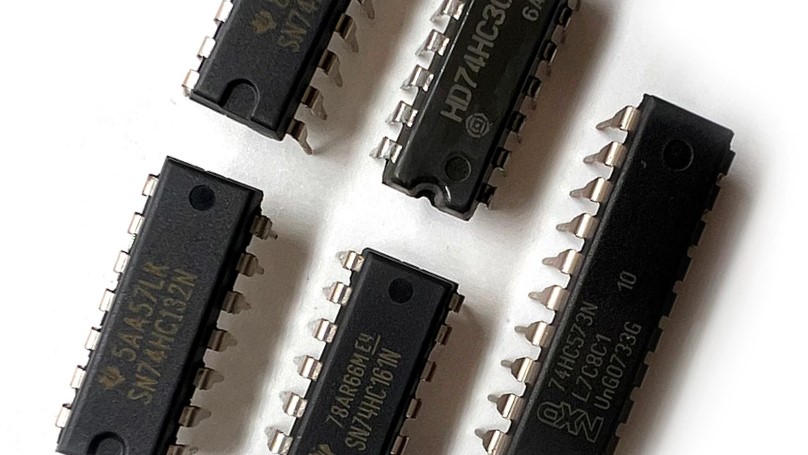
Why do 74-series logic ICs still matter? Spanning TTL to CMOS, this standardized family covers everything from decoders to bus buffers across 2–6V systems.
The 74 Series Logic ICs: A Detailed Guide and Selection Handbook