
Analog Multiplexer Uncovered: Principle and Essential Guide
2026-06-29
An analog multiplexer (MUX) is an electronic device that connects one of multiple analog input signals to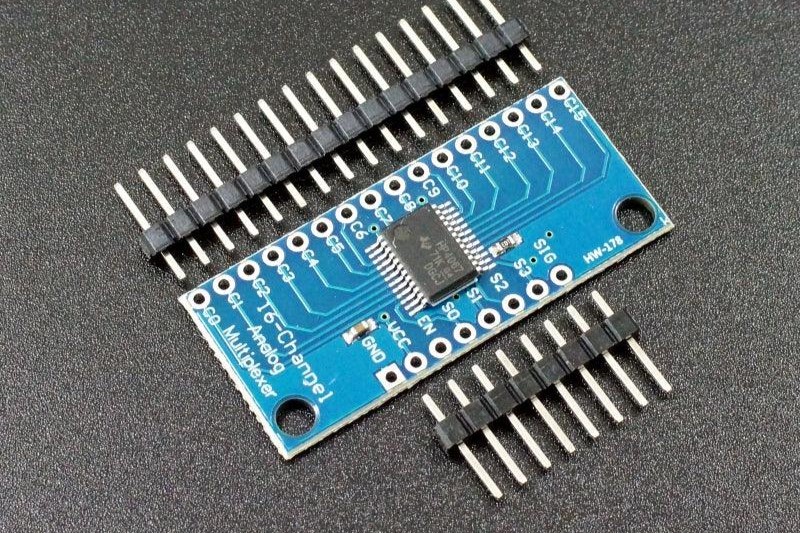 a single output channel. In modern electronic systems, the Analog Multiplexer IC plays a critical role: it allows multiple sensors or signal sources to share the same signal conditioning chain (such as amplifiers) and analog-to-digital converters (ADC), thereby significantly reducing component count, power consumption, and PCB area, while substantially lowering overall cost. Whether used for tens of sensors on an industrial automation production line, multiple body-control signals in automotive electronics, multi-channel physiological parameter acquisition in medical equipment, or signal routing in communication infrastructure, the Analog Signal Multiplexer has become an essential building block for a wide variety of complex electronic systems.
Analog Multiplexer vs Analog Switch
When selecting the right device, it is first necessary to clarify the distinction between an analog switch and an analog multiplexer. In essence, an analog multiplexer is composed of multiple analog switch cells arranged in a specific array structure, with digital address decoding logic used to control channel selection.
| Feature | Analog Switch | Analog Multiplexer |
| Number of Inputs | Single | Multiple |
| Number of Outputs | Single | Single |
| Control Method | Simple ON/OFF | Address control (binary coding) |
| Circuit Complexity | Lower | Higher |
| Typical Application | Signal on/off control | Multi-channel signal selection |
A typical CMOS Analog Multiplexer integrates multiple Analog Switch IC cells internally, each usually formed by an N-channel MOSFET and a P-channel MOSFET connected in parallel. This structure allows signals to be transmitted bidirectionally over positive and negative voltage ranges, with excellent rail-to-rail performance.
The most fundamental difference between an analog multiplexer and an analog switch is that the switch solves the simple question of "whether a certain signal path is conductive or not," whereas the multiplexer solves the path-selection question of "which one among many input signals should be routed to the output." For example, Texas Instruments' TMUX7612 is a 4-channel 1:1 switch, with each channel independently controllable. The TMUX8108, on the other hand, is an 8:1 multiplexer that uses three address lines to determine which input is connected to the output.
Important Application Areas of Analog Multiplexers
Industrial Analog Multiplexers are widely used in industrial control systems for PLC analog input modules, process control, and data-acquisition systems (Analog Multiplexer for data acquisition systems), enabling a single ADC to sequentially sample tens of sensor signals. Automotive Analog Multiplexers (compliant with AEC-Q100 standards) are applied in body-control modules, battery management systems (BMS), and multi-sensor signal acquisition, with operating temperature ranges typically required to span from -40°C to +125°C. In the medical field, Analog Multiplexer Applications include multi-channel physiological signal monitoring (e.g., ECG, EEG), medical imaging equipment, and more; in communication systems, they are used for audio/video signal routing and telecommunications switching.
Common Types of Analog Multiplexers and Key Parameters
Common analog multiplexers available on the market can be classified by channel count and topology into the following types:
- 2:1 Multiplexer (SPDT) – the most basic two-to-one switch, suitable for simple signal selection.
- 4:1 Multiplexer – four-to-one, often used in medium-channel-count systems.
- 8:1 Multiplexer – eight-to-one; due to its moderate channel count, it is the most common configuration in industrial control and medical equipment.
- 16:1 Multiplexer – sixteen-to-one, suitable for data-acquisition systems requiring a high number of channels.
- Differential Analog Multiplexer – handles differential signals and offers good common-mode noise rejection.
- Dual Multiplexer – a dual-channel multiplexer, for example a dual 4:1 configuration, providing two independent multiplexing functions in a single package.
- High-Speed Analog Multiplexer – designed specifically for high-frequency applications such as video, RF, and high-speed communications.
- Precision Analog Multiplexer – intended for precision measurement scenarios, characterised by extremely low leakage current and charge injection.
When selecting a device, special attention should be paid to the following key electrical parameters:
- On-Resistance (R_ON): the resistance between input and output when the switch is on. Choosing a Low On-Resistance Analog Multiplexer (e.g., 4 Ω) helps reduce signal attenuation and gain error.
- R_ON Flatness: the maximum variation of R_ON over the input voltage range; it affects signal linearity.
- Leakage Current: the tiny current that flows through a channel when the switch is off. A Low leakage analog multiplexer IC (e.g., 1 pA level) is crucial for high-impedance sensor and precision measurements.
- Charge Injection: the amount of charge injected into the signal path during switching transitions, which can cause output glitches.
- Bandwidth: the highest frequency range over which the signal can pass accurately. A High bandwidth analog multiplexer (e.g., 830 MHz) is suitable for video and high-speed communications.
- Off-Isolation: the ability to suppress signal leakage from an off-channel to the output.
- Crosstalk: unwanted signal coupling between adjacent channels.
- Transition Time: the time required to switch from one channel to another.
Popular Analog Multiplexer Families
Major semiconductor manufacturers offer a wide range of analog multiplexer product lines. Representative families include:
- Texas Instruments – The MUX36xxx series belongs to the Precision Analog Multiplexer category, with typical leakage current of only 1 pA and R_ON of 125 Ω. Tthe TMUX series covers high-voltage, automotive-grade, and radiation-tolerant options; the CD4xHC405x series provides high-speed CMOS-logic-compatible multiplexers.
- Analog Devices (including the former Maxim Integrated) – DG506A is a 16:1 single-ended multiplexer, DG507A is a differential 8:1. MAX4581 (8:1) and MAX4582 (dual 4:1) are general-purpose products. ADG5206/5207 feature latch-up protection. ADG1408 achieves an ultra-low on-resistance of 4 Ω.
- onsemi – The HC/HCT series covers various switch types such as SPDT, DPDT, and SPST. The MC74HCT4852A is specifically optimised for injection-current effects.
- NXP Semiconductors – HEF4067B provides 16:1 multiplexing, HEF4052B is a dual 4:1, and the 74HC4052 series is also widely used.
- STMicroelectronics – HCF4051 is an 8:1 multiplexer with low on-resistance and extremely low off-state leakage current. M74HC4851 enhances injection-current control, making it suitable for automotive applications.
- Renesas Electronics – The HI-506A/507A/508A/509A series integrates active over-voltage protection. The ISL84051/052/053 series are low-voltage precision bidirectional switches with bandwidth up to 830 MHz.
- Infineon Technologies – Offers configurable analog multiplexer (AMux) components that support flexible configurations from 1 to 64 single-ended connections or 1 to 32 differential connections.
Future Trends in Analog Multiplexer Technology
Currently, with the continuous evolution of semiconductor technology and application demands, the Analog Multiplexer technology is developing in the following directions. First, Higher Bandwidth, AMUXs using SiGe and InP processes have been applied in ultra-high-speed optical communication. Second, Higher Precision, Low leakage analog multiplexer ICs and ultra-low charge injection technologies are continuously advancing. Third, Higher Integration, the multiplexers are further integrated with functional modules such as ADCs and amplifiers. Fourth, Automotive Intelligence, the demand for automotive-grade analog multiplexer ICs has exploded with the growth of electric vehicles and autonomous driving. Finally, Miniaturization and Low Power Consumption, smaller packages (such as WQFN) and lower power consumption designs.
SEMICONE, as a professional electronic component supply service provider, is dedicated to offering customers stable supply and technical selection support for a full range of analog signal-chain products, including Analog Multiplexer IC and Analog Switch IC, helping engineers efficiently complete the entire design process from selection to mass production.
Website: www.semicone.com
Email: info@semicone.com
High-Purity CO₂ Supply Warning: Semiconductor Faces Raw Material Shortage
Semiconductor M&A: onsemi Acquires Synaptics for $7 Billion
Related Article

NXP issues its third 2026 price hike, effective January 1, 2027, without disclosing increases or part lists, as costs and lead times stretch and industry-wide price hikes continue.
NXP's Three Price Rounds in 2026: Increases, Part Numbers, and Cost Pressure
onsemi signs $775M cash deal for Ferric, adding IVR tech to bring AI power delivery closer to the compute core and lifting its 2030 AI data center target above $3B.
onsemi to Acquire Ferric for $775M, Expanding AI Power Management Layout