Semiconductor EUV Tech Shock: SK Hynix's EUV Team Disbandment
2024-12-27
Recently, a significant event has occurred in the semiconductor industry: SK Hynix has disbanded its EUV (Extreme Ultraviolet) technology team. This decision has immediately attracted widespread attention in the industry, as it involves the future and competitive landscape of global semiconductor manufacturing technology. EUV Extreme Ultraviolet technology is irreplaceably important in modern chip manufacturing and other fields. It can achieve smaller chip processes, thereby enhancing chip performance and reducing power consumption, making it one of the key technologies driving electronic devices towards being smaller, faster, and smarter.
Event Details
According to industry insiders, SK Hynix decided to disband the EUV TF during this year's restructuring and transfer it to the Future Technology Research Institute. SK Hynix's EUV TF was organized in 2019, and last year, personnel scattered across various business departments and the Future Technology Research Institute were all integrated into the EUV TF and operated as a permanent institution. This change signifies a strategic adjustment by SK Hynix in the application and future development of EUV technology.
Meanwhile, Samsung Electronics has adopted a different strategy. Samsung Electronics has established the "EUV Synergy TF" under the Global Manufacturing Infrastructure General Manager through year-end restructuring. The goal of this new team is to maximize the productivity of ASML's exclusive supply of EUV exposure machines, Tokyo Electron's EUV track equipment, and various materials and components used in the exposure machines.
Technological Impact
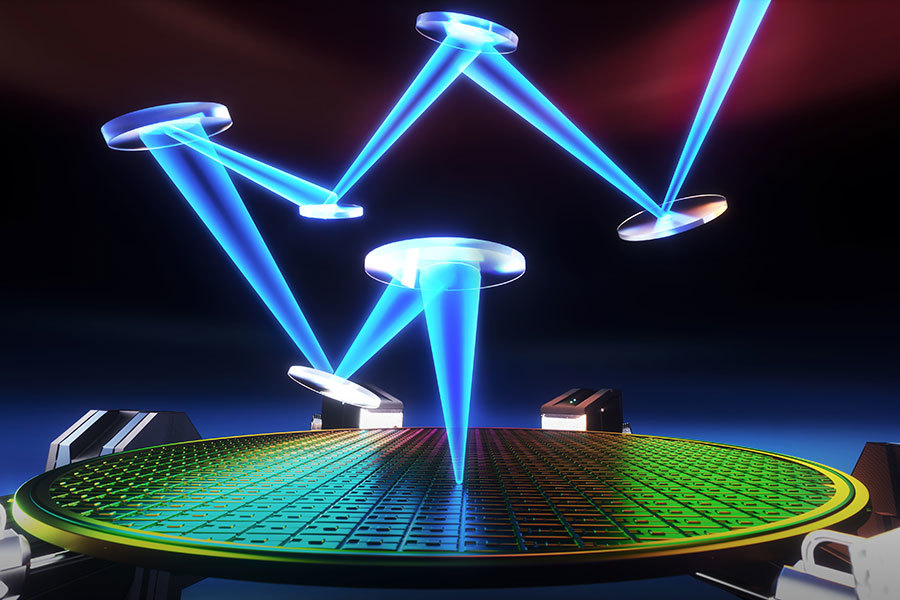
EUV exposure technology is a technology that uses EUV light to print semiconductor circuits onto wafers. The wavelength of this EUV light is only 13.5 nanometers, a quarter shorter than the existing argon fluoride (ArF) light, thus allowing for the creation of finer circuits than before. However, this light has a characteristic that makes it difficult to be absorbed by most objects, so mastering EUV technology is not easy.
The technology faces a series of complex technical challenges. The generation of high-power extreme ultraviolet light requires special light source materials and optical system design. For example, when generating high-power extreme ultraviolet light, issues such as plasma instability can occur, affecting the stable output of light. Moreover, the mask technology in the photolithography process of extreme ultraviolet light also has high requirements, and it is necessary to overcome problems such as light scattering and absorption to ensure the accuracy of the photolithography pattern. These technical challenges have been difficult to effectively overcome over a long period.
Industry Competition
In the field of semiconductor manufacturing, competition for EUV technology is very fierce. Samsung Electronics and TSMC are actively promoting the application of EUV technology to improve yield and competitiveness. Samsung Electronics currently has more than 30 EUV exposure machines in its Hwaseong and Pyeongtaek factories. TSMC is expected to receive the world's most advanced chip manufacturing equipment from ASML by the end of this year—the high numerical aperture extreme ultraviolet lithography machine. This news marks another significant step for TSMC in the field of semiconductor manufacturing.
Conclusion
The event of SK Hynix disbanding its EUV team reflects the dynamic changes in the semiconductor manufacturing industry in terms of technological development and market competition. Different companies adopt different strategies to cope with the challenges and opportunities brought by EUV technology. This event will also have a profound impact on the global semiconductor supply chain and competitive landscape. As technology continues to advance and competition intensifies, the development and application of EUV technology will continue to be a focus of attention in the semiconductor industry.
Semicone IC Resources
Semicon, a leading electronic component supplier, offers a wide range of integrated circuit (IC) solutions. We provide both hard - to - find IC parts and detailed IC data. If needed, contact us for help. Here are some of our best - selling semiconductor models.
-
The TS5A3160DCKR is a single-pole double-throw (SPDT) analog switch designed to operate within a voltage range of 1.65 to 5.5V. It features a low on-state resistance of 1.1 ohms and offers excellent channel-to-channel on-state resistance matching. This device is known for its low power consumption, high total harmonic distortion (THD) performance, and specified break-before-make switching.
-
The USB3340-EZK-TR is a USB Type-C and Power Delivery (PD) controller chip designed for easy integration into electronic devices. It supports USB PD 3.0 and Power Delivery 2.0 standards, enabling efficient power management and fast charging capabilities. This chip features an integrated power path management, which allows for seamless switching between different power sources.
-
The TM4C123GH6PGEI7 is a member of the Tiva C Series™ microcontroller family from Texas Instruments. It is based on the ARM Cortex-M4F processor, which offers high performance and floating-point capabilities. This microcontroller features 128 kB of flash memory and 24 kB of SRAM, along with a variety of peripherals.
Email: info@semicone.com
South Korea's Chip Exports Reach Record High in 2024 with 43.9% Growth
Hyundai Disbands 5nm Chip Team: Strategic Adjustments and Future Prospects
Related Article
Ericsson will merge Northeast Asia with Southeast Asia, Oceania and India into one APAC unit and dissolve its enterprise wireless division, effective Jan 1, 2027.
Ericsson Merges Asia-Pacific Regions, Dissolves Enterprise Wireless Division
NVIDIA prepays KYEC to secure US testing capacity. KYEC and its AeternZ subsidiary will build the capacity, repayment offsets future service fees.
NVIDIA Prepayment Lock KYEC's US Testing Capacity