
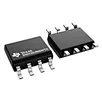
Model No: TCA39306DDFR
Texas Instruments TCA39306DDFR
Manufacturer: Texas Instruments
SEMICON NO.: TCA39306DDFR
Package: TSOT-23-8
Stock: In stock
Description: Translator Voltage Level 1 Circuit Channel
SEMICON NO.: TCA39306DDFR
Package: TSOT-23-8
Stock: In stock
Description: Translator Voltage Level 1 Circuit Channel
Quantity :
| Mfr | Texas Instruments |
| Device Type | Dual Bidirectional I²C Bus / SMBus Voltage-Level Translator |
| Voltage Translation Range | Side 1: 0.9 V to 3.3 V, Side 2: 1.8 V to 5.5 V |
| Number of Channels | 2 (SDA and SCL) |
| Number of Circuits | 1 |
| Channel Type | Bidirectional |
| I/O Port Type | Open-Drain |
| I/O Voltage Tolerance | 5V tolerant I²C I/O ports |
| Propagation Delay (Typ) | 46 ns |
| Charged-Device Model (CDM) | 1000 V (C101) |
| Operating Temperature | –40°C to +125°C |
| Package | TSOT-23-8 |
| Mounting Type | Surface Mount |
| Compliance | RoHS Compliant |
The TCA39306DDFR is a Texas Instruments dual bidirectional voltage-level translator designed for mixed-mode I2C bus applications, translating the SDA and SCL lines between two voltage domains without requiring a direction pin. Compatible with I2C standard-mode, fast-mode and fast-mode plus, as well as SMBus, it also supports I3C operation up to 12.5 MHz, making it a forward-looking choice for next-generation sensor and management buses. This orderable comes in an SOT-23-THN (DDF) package, rated -40°C to +125°C.
Key Features
● 2-bit bidirectional translator dedicated to SDA and SCL lines in mixed-mode I2C systems.
● Full protocol support: I2C standard, fast and fast-mode plus, SMBus, and I3C up to 12.5 MHz.
● Wide translation range covering 0.9 V, 1.2 V, 1.8 V, 2.5 V and 3.3 V on VREF1 against 1.8 V, 2.5 V, 3.3 V or 5 V on VREF2, spanning 0.85 V to 5 V overall.
● Low ON-state resistance pass switches for minimal propagation delay and low signal distortion.
● Open-drain I2C I/O ports (SCL1, SDA1, SCL2, SDA2) that are 5 V tolerant for mixed-mode operation.
● Active-high enable pin for bus isolation, with high-impedance, lockup-free behaviour when EN is low.
● Strong ESD protection exceeding JESD 22: 2000 V human-body model and 1000 V charged-device model.
Applications
This I2C level shifter is used wherever a controller and its peripherals run on different supply rails: servers, routers and telecom switching equipment, personal computers and notebooks, and industrial automation controllers. It suits I2C, SMBus, PMBus, MDIO, UART, low-speed SDIO and GPIO interfaces, bridging modern 1.8 V or 0.9 V processors to legacy 3.3 V or 5 V peripherals such as EEPROMs, sensors, PMICs, fan controllers, port expanders and thermal monitors. The EN pin also makes it valuable for segmenting bus capacitance, hot-swap isolation and disconnecting slower devices during high-speed communication.
FAQ
Q: Does it need a direction control signal? No, translation is fully bidirectional and automatic, so no direction pin is required.
Q: What supply rule applies? VREF1 is always the lower rail and VREF2 the higher one, so VCCA must be less than or equal to VCCB.
Q: Are pull-up resistors needed? Yes, the ports are open-drain, so pull-ups to the appropriate rail are required on both sides of the bus.


