Meta Abandons In-House AI Chips, Embraces Google TPU
2026-02-27
Meta's AI chip autonomy strategy is encountering systemic failure. Following the abandonment of its second-generation training chip Iris in 2024, the company officially terminated its most advanced Olympus project in February 2026. Iris adopted a SIMD architecture that, while relatively simple in hardware design, suffered from high software programming complexity and low AI model training efficiency. Olympus, utilizing an SIMT architecture similar to NVIDIA's, was led by the Rivos team acquired by Meta in October 2025 and promised CUDA code compatibility. However, executives ultimately determined that its software stability was insufficient, its design too complex for mass production scalability, and the risks too high amid intense competition with OpenAI and Google.
The successive failures of two flagship training chips expose Meta's deep-seated dilemma in the semiconductor sector—a lack of substantial engineering teams to support complex chip development and an inability to guarantee the commercial viability of final products.
Strategic Pivot to Google TPU
With the in-house development path blocked, Meta rapidly shifted to external procurement. In February 2026, Meta reached a multi-year, multi-billion dollar agreement with Google to rent Google's TPUs (Tensor Processing Units) for developing new AI models, and is negotiating to directly purchase TPUs for deployment in its own data centers as early as 2027. This marks the first time Google TPUs have entered hyperscale data centers as a NVIDIA alternative, breaking their previous limitation of being available only through Google Cloud rental.
In February 2026 alone, Meta successively signed agreements to purchase millions of GPUs from NVIDIA, established a five-year, $100 billion partnership with AMD to procure 6 gigawatts of MI450 computing power, and embraced Google TPUs—forming a tripartite supplier structure. Mark Zuckerberg declared plans to deploy "tens of gigawatts" of computing power by 2030, with capital expenditures reaching $115-135 billion in 2026, a scale that no single supplier can satisfy.
Google TPU's Competitive Advantages
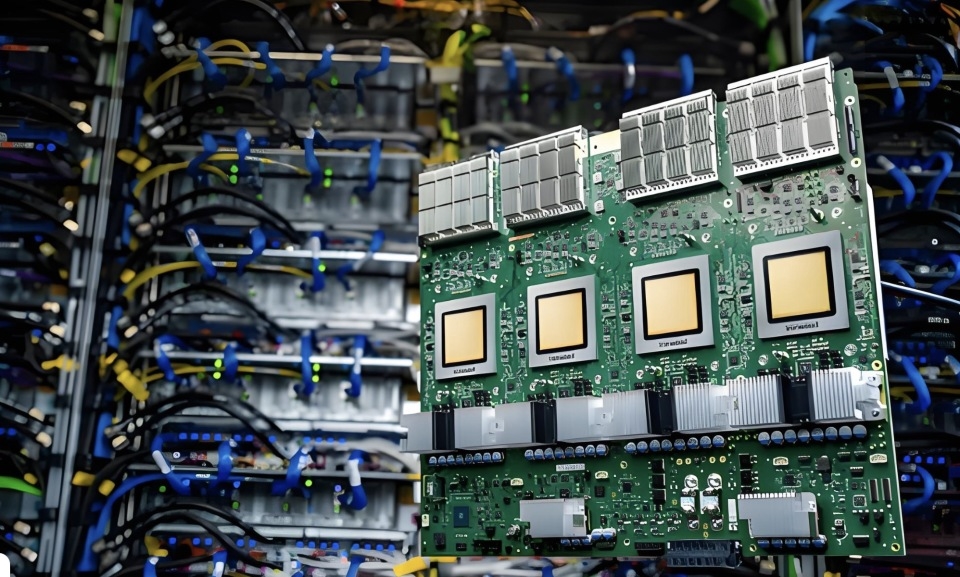 Google TPUs' appeal stems from their system-level cost-performance ratio. The Gemini 3 and 4 models have already demonstrated TPU feasibility in the training domain—95-100% of training workloads run on TPUs, with NVIDIA GPUs accounting for only 0-5%. The seventh-generation Ironwood chip delivers 4x performance improvement over its predecessor, is optimized specifically for inference, supports supernodes of up to 9,216 chips, and achieves 2-3x better energy efficiency than GPUs.
For Meta, TPUs not only provide computing diversification but also create cost optimization opportunities. Santosh Janardhan, Meta's Global Infrastructure Head, stated, "At our current scale, all three options [in-house, AMD, NVIDIA] have their place," and the addition of TPUs is completing this layout.
Industry Landscape Restructuring
Meta's pivot reveals a paradigm shift in the AI infrastructure industry: from sole reliance on NVIDIA's CUDA ecosystem toward multi-supplier competition. Through its "TPU-as-a-Service" model and partnerships with companies like Broadcom, Google is building a complete industrial chain rivaling NVIDIA's. Broadcom's CEO revealed that beyond Google, the company has secured a fifth XPU custom chip customer, with quarterly orders reaching $1 billion.
Semicone Featured IC Recommendations
Semicone operates as a premier independent distributor of semiconductor integrated circuits, maintaining strategic inventory across high-demand categories including precision analog, power management, automotive-grade logic, and RF components. Here are some of selection represents components.
|
Part Number
|
Manufacturer
|
Core Function
|
|
Analog Devices
|
16-bit, 25 MSPS high-performance ADC with 70 dB SNR and serial LVDS outputs
|
|
|
Texas Instruments
|
Dual-channel, ultra-low-noise LDO regulator featuring 3.8 µVRMS noise floor and 75 dB PSRR at 1 MHz
|
|
|
NXP Semiconductors
|
Automotive-grade CAN transceiver with ±8 kV ESD protection and standby mode for low-power operation
|
|
|
Nexperia
|
40V, 200 mA planar Schottky barrier diode with integrated guard ring protection
|
Email: info@semicone.com
SK Hynix and SanDisk Launch HBF Standardization Alliance
Apple Considers Adopting Memory chips from CXMT and YMTC
Related Article
Microchip acquired VORAGO and Hailo. VORAGO adds HARDSIL tech, Hailo brings 26 TOPS processors. Both deals closed in 2026.
Microchip's Two Acquisitions: Aerospace & Defense and Edge AI

MOSFET or IGBT? Learn how to choose power semiconductors by voltage, switching frequency, and load.
MOSFET or IGBT? A Practical Guide to Power Device Selection